
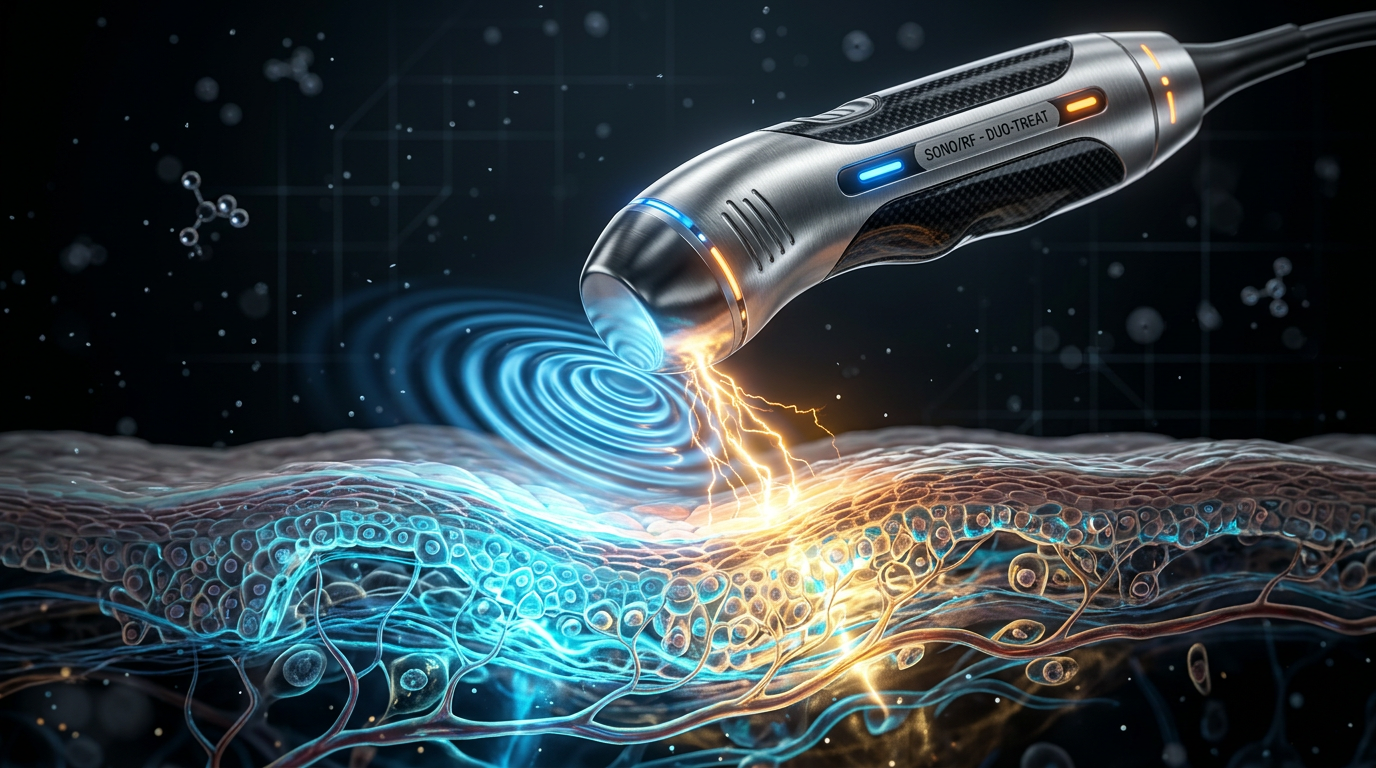
Ultrasound and Radiofrequency: How They Work Deep in the Dermis
Radiofrequency and ultrasound are both marketed as ways to tighten skin by reaching deep beneath the surface, and patients often assume they're more or less the same technology with a different name. They're not. They deliver energy in fundamentally different ways, and that difference is exactly why, at Adare Dermatology Clinics in Dublin, Limerick and London, we use one and not the other.
Radiofrequency: Heating the Dermis with Precision
Radiofrequency, or RF, works by heating tissue. An electrical current passes through the skin, and the tissue's natural resistance to that current generates heat exactly where the current travels. That heat causes existing collagen to contract immediately, which is what gives an early tightening effect, and it also triggers a wound-healing response that stimulates fibroblasts to lay down new collagen over the following weeks and months.
The machine we use, Secret RF, delivers this energy through fine needles inserted directly into the skin, rather than simply passing it across the surface. This matters enormously, because it means we know exactly how deep into the dermis the energy is being placed, needle by needle. As a medical clinic staffed by doctors, we're also insured to treat at greater depths than many aesthetic providers, which allows us to place the energy precisely where it will do the most good for your specific concern, rather than being limited to a shallower, one-size-fits-all setting.
Why RF Results Vary So Wildly Between Clinics
This is a question we're asked often, usually along the lines of: “my friend had RF and got fantastic results, but I had it somewhere else and saw nothing — why?” The answer usually comes down to precision of delivery. Radiofrequency energy travels as a wave, and if it isn't delivered directly into the tissue via a needle at a controlled depth, that wave can miss its intended target in the dermis almost entirely, particularly with surface-applied or non-fractionated RF devices. The current can simply pass through or dissipate before it reaches the depth needed to genuinely stimulate collagen, leaving the patient with little more than mild warmth and no lasting effect. Two friends can have what looks, from the outside, like “the same treatment,” on two different machines, or even the same machine used by two practitioners with different training, and end up with completely different results, simply because one delivered the energy precisely into the target tissue and the other didn't.
What RF Can Realistically Achieve

Used correctly, RF genuinely does tighten the skin and improve texture over time, and it's an excellent option for patients who want visible improvement without significant downtime. But it's important to be honest about where it sits: it cannot be directly compared to a phenol peel or a CO2 laser in terms of the depth of change achievable. Those treatments cause a controlled, deliberate injury to the skin's surface and deeper layers to force a much more dramatic remodelling response. RF is gentler, doesn't ablate the surface at all, and is better suited to patients looking for steady, cumulative improvement with little to no time off, rather than the dramatic single-treatment transformation a more aggressive resurfacing procedure can deliver.
Ultrasound: Why We Don't Offer HIFU at Adare Dermatology Clinics
High-intensity focused ultrasound, or HIFU, is a technology some clinics use for non-surgical skin tightening, and it works differently again: instead of heating tissue along the path of an electrical current, focused ultrasound waves converge at a specific depth, often targeting the same fibrous layer addressed surgically in a facelift, to create a small, controlled zone of thermal injury that triggers collagen tightening.
We don't currently offer HIFU treatments at our clinics, and the reasoning comes down to a genuine safety concern we haven't seen adequately resolved. For HIFU to meaningfully tighten skin, the energy generally needs to reach a significant depth, and several areas of the face have nerve branches running close to the surface, particularly around the jawline and in front of the ear. Published case reports and safety reviews of HIFU have described instances of facial nerve injury, including transient numbness and localised weakness in these areas, occurring specifically when energy has been delivered deep enough to reach that fibrous layer. Most cases resolve with time, but the concern isn't a hypothetical one, and it's the reason we've taken a cautious position: if a treatment needs to go deep enough to meaningfully tighten skin, we want that depth to be precisely, directly controlled and directly targeted, in a way we can verify, and we're not currently satisfied that ultrasound offers that same degree of control at the depths needed for a genuine tightening effect.
This is why we continue to rely on our RF microneedling platform for tightening rather than ultrasound: it lets us place energy at a specific, known depth in the dermis, needle by needle, under direct medical supervision, rather than relying on a converging wave whose exact behaviour deeper in the tissue is harder to verify treatment by treatment.
Choosing the Right Tool for the Right Depth
Both radiofrequency and ultrasound are, in principle, trying to do the same underlying job: reach the dermis and deeper structural layers with enough controlled heat to trigger new collagen production and visible tightening. But how precisely, and how safely, that energy actually reaches its target varies enormously between technologies, machines and practitioners. At Adare Dermatology Clinics across Dublin, Limerick, or London, our approach is to use the technology we can control and verify most precisely for your specific skin and goals, rather than defaulting to whatever is newest or most heavily marketed.
If you're considering a tightening treatment and want an honest assessment of what will actually work for your skin, book a consultation with one of our dermatologists. We'll talk you through exactly how deep your concern needs to be addressed, and which of our treatments is genuinely capable of reaching it safely.

Leave a comment
This site is protected by hCaptcha and the hCaptcha Privacy Policy and Terms of Service apply.