
Sunscreen and Hyperpigmentation: Why the Ingredients Matter More Than the Brand
Of everything we recommend for hyperpigmentation at ADC—whether that’s melasma, post-inflammatory hyperpigmentation, or sun-induced pigmentation—sunscreen is the one non-negotiable.
No serum, peel, laser, or prescription treatment will hold its results if photoprotection isn't right. But not all sunscreens are equal. For pigmentation specifically, the brand name matters far less than what's actually inside the bottle and which light wavelengths it is engineered to block.
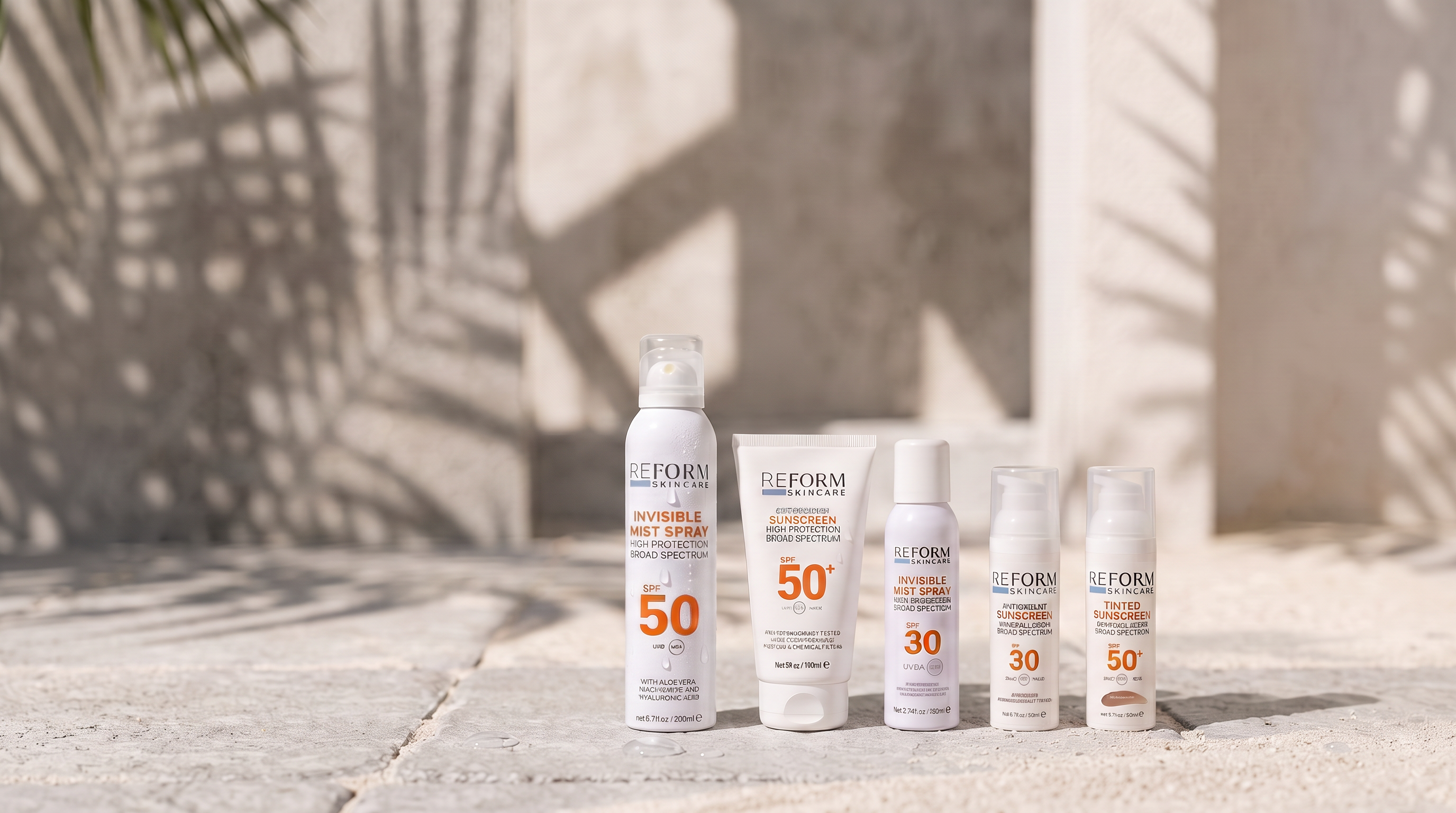
Why We Focus on REFORM Skincare Sunscreens
Our dermatologists and specialists at ADC formulate and recommend REFORM Skincare sunscreens because we understand precisely what is in them and exactly what each ingredient targets.
It isn't about one brand being superior for the sake of marketing; it's about clinical confidence. The doctors treating you know these formulations inside out—down to the specific filter system and wavelength coverage—allowing us to match the exact product to your individual pigmentation pattern.
SPF Alone Is Not Enough

For any patient managing hyperpigmentation, we recommend SPF 50+ as standard.
However, SPF only measures protection against UVB—the rays responsible for sunburn. But UVB is only part of the story. Hyperpigmentation, and melasma in particular, is driven at least as much by UVA radiation. A high SPF number alone tells you nothing about how well a sunscreen handles long-wave UVA exposure.
Critical Wavelength: The Number That Actually Matters for Melasma
This brings us to critical wavelength—a metric most patients have never heard of. Critical wavelength measures how far into the long-wave UVA spectrum a sunscreen’s protection extends. The higher the number, the broader and deeper the UVA coverage.
Why this matters for melasma: Long-wave UVA penetrates deeply into the dermis and acts as a primary trigger for melanocyte activity (the pigment-producing cells responsible for melasma).
REFORM’s SPF 50+ achieves a critical wavelength of 380nm, representing excellent, genuinely long-range UVA protection. This is the exact benchmark we look for when a sunscreen needs to actively combat melasma rather than just meeting minimum broad-spectrum standards.
Visible Light: The Trigger Most Sunscreens Ignore
UVA and UVB aren't the only culprits. Visible light—including high-energy visible light (HEVL), the spectrum we can see with the naked eye—is now well recognised as a major trigger for pigmentation, particularly in melasma and deeper skin tones.
Standard chemical and physical UV filters do very little to block visible light.
This is why we recommend sunscreens containing iron oxide. Iron oxide filters specifically target and block visible light, providing a shield that standard SPFs miss. For patients with melasma, iron oxide isn't a cosmetic extra—it's a core component of your treatment plan.
What We Look For in a Pigmentation-Focused Sunscreen
When evaluating a sunscreen for a hyperpigmentation patient, we ask four critical questions:
-
Is the SPF 50+? (Ensuring high-level UVB protection)
-
What is the critical wavelength? (Does it reach 380nm for long-wave UVA coverage?)
-
Does it contain iron oxide? (Blocking visible light triggers)
-
Is it cosmetically elegant? (Will you actually enjoy wearing it every day?)
That last point is often underestimated, but it is frequently the difference between a treatment that works in theory and one that works in practice. A formula that leaves a heavy white cast, feels greasy, or pills under makeup is a formula patients quietly stop using. REFORM’s sunscreens are formulated to sit comfortably under skincare and makeup because consistent, daily use is what actually keeps pigmentation at bay.
Acne-Induced Hyperpigmentation Needs a Different Approach
A large portion of the hyperpigmentation we treat at ADC is post-inflammatory marks left behind by acne. Patients with oily or acne-prone skin require a tailored sunscreen strategy—the wrong formula can clog pores and exacerbate breakouts.

For these patients, the goal is strong photoprotection without pore-blocking ingredients:
-
REFORM SPF 30 Mineral Cream: Mineral formulations sit on the skin’s surface rather than absorbing into pores, making them ideal for acne-prone skin. While physical mineral filters can sometimes feel slightly chalky, this is easily managed by layering the cream over a 20% vitamin C serum and a light moisturizer for a smooth finish.
-
REFORM SPF 30 Mist Spray: For patients seeking a simpler, weightless alternative, this non-greasy mist offers non-comedogenic protection that won't block pores or leave a white cast on darker skin tones.
This same logic applies to post-inflammatory hyperpigmentation caused by keratosis pilaris and folliculitis. Heavy formulas that clog pores risk inflaming the underlying condition, ultimately prolonging the very pigmentation you are trying to heal.
Why Sunscreen Matters More Than People Expect
Patients are often surprised by our intense focus on sunscreen when they come to us for targeted treatments like melasma protocols, topical actives, or chemical peels.
However, no active ingredient—whether it's Vitamin C, tyrosinase inhibitors, prescription tranexamic acid, or hydroquinone—can outpace ongoing UV and visible light damage. Treating pigmentation while skipping proper photoprotection is like pouring water into a leaking bucket.
This is especially critical in Ireland and the UK, where patients routinely underestimate daily UVA exposure. UVA rays penetrate glass and pass through clouds. Daily exposure through car windows during your commute or sitting near office windows adds up silently over time, whether it feels hot outside or not.
Reapplication and Realistic Habits
Even the best formulation only works if it is applied in sufficient quantities and reapplied throughout the day.
We encourage our patients to view sunscreen as a daily, non-negotiable habit—just like brushing your teeth. Apply it every morning regardless of the weather, top it up during the day (especially during prolonged outdoor exposure), and pair it with physical measures like wide-brimmed hats and UV-blocking sunglasses.
Sunscreen Is the Foundation, Not an Add-On
Whether you are treating melasma, clearing post-acne marks, or taking preventive measures against aging, the right sunscreen is the foundation of your skin health. At ADC, our dermatologists select formulations based on proven metrics—SPF rating, critical wavelength, and visible light protection—not marketing buzzwords.
Ready to Take the Next Step?
If you are struggling with stubborn hyperpigmentation or want to build a preventative skincare routine tailored to your skin type, our specialist team is here to help.



Leave a comment
This site is protected by hCaptcha and the hCaptcha Privacy Policy and Terms of Service apply.