
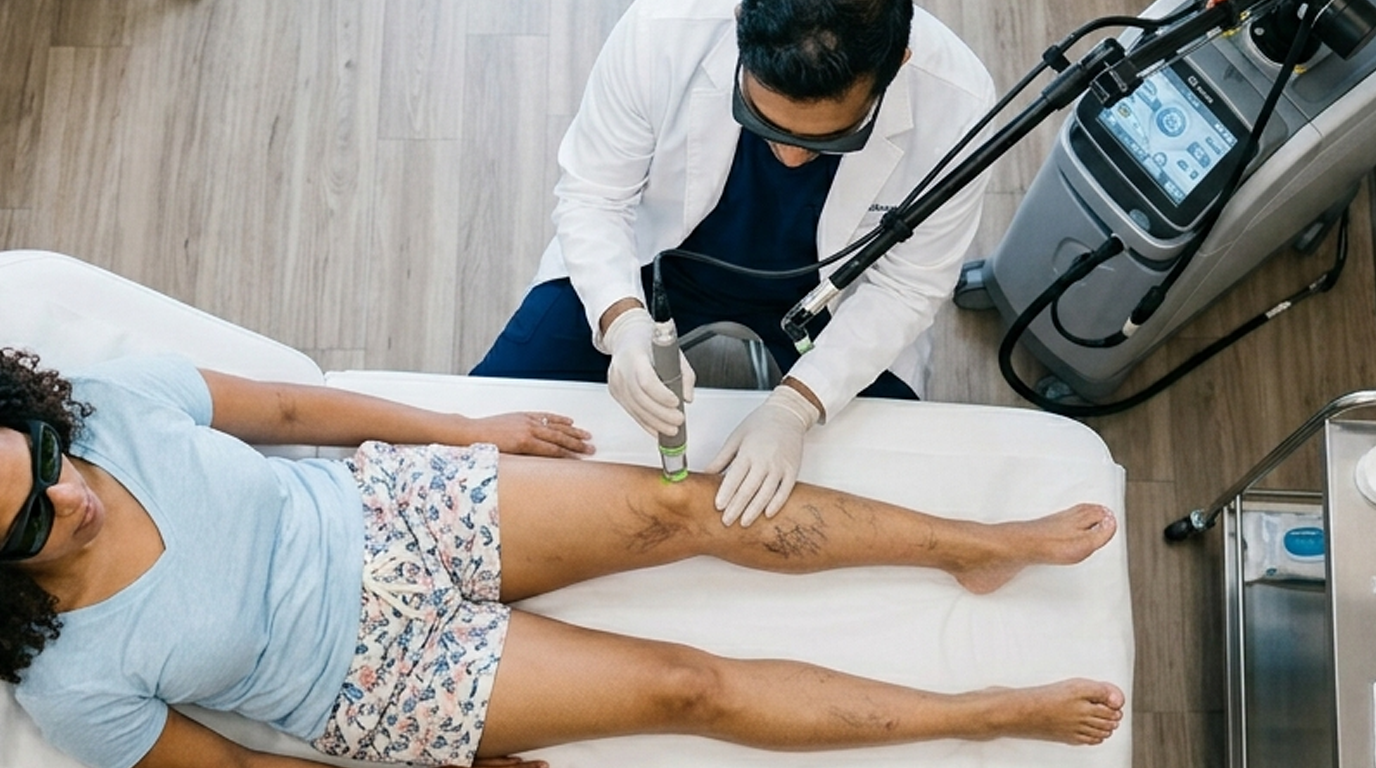
Laser Vein Removal: Clear Broken Capillaries Permanently
If you've ever glanced in the mirror and noticed a faint web of red or purple lines spreading across your nose, cheeks, or legs, you're not alone. Broken capillaries and thread veins are among the most common cosmetic concerns affecting people of all skin types and ages — and for many, they're a persistent source of frustration. Concealer can only do so much. The good news? Modern laser technology has made clearing these vessels safer, faster, and more effective than ever before.
Here's everything you need to know about laser vein removal — how it works, what to expect, and why it delivers results that creams and home remedies simply cannot match.
What Are Broken Capillaries and Thread Veins?
Before diving into the treatment itself, it helps to understand what you're actually dealing with.
Broken capillaries — also called telangiectasia — are tiny, dilated blood vessels that have become permanently widened just beneath the surface of the skin. They appear as fine red, pink, or purple lines, often concentrated around the nose, cheeks, and chin. Despite the name, they aren't literally broken; they've simply lost their elasticity and can no longer contract back to their original size.
Thread veins (sometimes called spider veins) are a close relative — slightly larger vessels that fan out in a spider-web pattern, most commonly on the legs and ankles. They sit just below the skin's surface and are typically blue, purple, or red in colour.
Both conditions are generally harmless from a medical standpoint, but they can significantly affect confidence and self-image. Common triggers include:
- Sun damage — UV exposure weakens vessel walls over time
- Rosacea — a chronic skin condition that causes persistent facial redness
- Hormonal changes — pregnancy, menopause, and contraceptives can affect vessel integrity
- Genetics — a strong family history is one of the biggest risk factors
- Trauma or pressure — anything from vigorous face washing to sneezing can rupture delicate capillaries
- Alcohol consumption — causes repeated dilation of facial blood vessels
- Ageing — skin thins and loses collagen, making vessels more visible
Once a capillary or thread vein has become permanently dilated, it won't resolve on its own. This is precisely where laser treatment changes the game.
How Laser Vein Removal Works
The science behind laser vein removal is elegantly straightforward, built on a principle called selective photothermolysis.

Every wavelength of laser light is absorbed preferentially by a specific target — called a chromophore — within the skin. In the case of vascular treatments, that target is oxyhaemoglobin, the pigment that makes blood red. When the laser energy is directed at the skin, it passes harmlessly through the surrounding tissue and is absorbed selectively by the haemoglobin inside the unwanted vessel.
This absorption generates heat. The heat damages the vessel wall, causing it to collapse and seal shut — a process called coagulation. Once sealed, the vessel is no longer functional. Over the following weeks, your body's natural immune and lymphatic systems gradually break down and reabsorb the dead vessel tissue. The result: the vein fades and eventually disappears.
The entire process is targeted, controlled, and tissue-specific. Surrounding skin, nerves, and healthy vessels are left essentially unaffected.
Which Lasers Are Used?
Not all laser systems are created equal, and the right device depends on the vessel type, depth, size, and your skin tone. In professional clinics, the most commonly used technologies for vascular work include:
Nd:YAG Laser (1064 nm) — The workhorse of vein removal for deeper, larger vessels and for darker skin tones. Its longer wavelength penetrates deeper into tissue, making it highly effective for leg thread veins and reticular veins. It is also considered one of the safest options for melanin-rich skin, as it is less likely to cause pigmentation changes.
KTP / Green Laser (532 nm) — Highly absorbed by oxyhaemoglobin, making it exceptionally precise for superficial facial capillaries and fine red thread veins. It produces excellent results on lighter skin tones.
Pulsed Dye Laser (PDL, 585–595 nm) — A long-standing gold standard for rosacea-related redness, facial flushing, and fine broken capillaries. PDL targets haemoglobin with great precision and has a well-established safety profile.
Intense Pulsed Light (IPL) — Technically not a laser (it emits a broad spectrum of light), but widely used for diffuse redness and mild capillaries. IPL is best suited to generalised redness rather than discrete, individual vessels.
Your clinician will assess your skin type, the vessels being treated, and their depth before recommending the most appropriate device or combination approach.
What Does the Treatment Feel Like?
One of the most common questions patients ask is: does it hurt?
Most people describe the sensation as a quick snap or flick — similar to a small elastic band against the skin. The discomfort is brief and manageable, and many modern systems incorporate cooling mechanisms (chilled air, cryogen sprays, or sapphire cooling tips) that significantly reduce the sensation during treatment.
A typical session for facial capillaries takes 15 to 30 minutes. Leg vein treatments may take slightly longer depending on the area covered. There's no need for anaesthetic in most cases, though a topical numbing cream can be applied beforehand for sensitive patients or larger areas.
What Happens After Treatment?
Immediately after the session, the treated area will look flushed and feel warm — similar to mild sunburn. In some cases, particularly on the legs, you may notice slight bruising or darkening of the vessel before it clears. This is completely normal and is actually a sign that the treatment has worked.
A typical recovery timeline looks like this:
- Days 1–3: Redness, warmth, and mild swelling at the treatment site. Facial capillaries may look temporarily darker or more prominent.
- Days 3–7: Initial fading begins. Bruising (if any) starts to resolve.
- Weeks 2–6: Gradual reabsorption of the treated vessels. Most patients see significant clearing within this window.
- Week 6 onward: Full results become visible. A follow-up review is usually scheduled at this point.
Aftercare is minimal. You'll be advised to avoid sun exposure, keep the area moisturised, skip vigorous exercise for 24–48 hours, and apply SPF diligently. Most people return to normal daily activities immediately after treatment.
How Many Sessions Are Needed?
This depends on the severity, size, and number of vessels being treated. For isolated facial capillaries, one to two sessions are often sufficient. More extensive rosacea-related redness or a network of leg thread veins may require three to five sessions, spaced four to six weeks apart.
It's important to set realistic expectations: even with the most advanced laser technology, vessels don't vanish overnight. The body needs time to reabsorb what the laser has sealed. Patience between sessions is just as important as the treatment itself.
Is It Really Permanent?
This is the question that matters most — and the answer is a qualified yes.
Once a vessel has been successfully coagulated and reabsorbed, it does not come back. The treated vein is gone permanently. However, laser vein removal doesn't change the underlying predisposition that caused the vessels to develop in the first place. If you have rosacea, significant sun exposure, or a genetic tendency toward vascular changes, new vessels can form over time.
This is why long-term management matters. Consistent sun protection, a gentle skincare routine, avoiding known triggers (excess heat, alcohol, spicy foods for rosacea sufferers), and occasional maintenance treatments when needed will keep results looking their best for years.
Think of it less as a one-time fix and more as an ongoing commitment to skin health — one where laser remains the most powerful tool available.
Who Is a Good Candidate?
Laser vein removal is suitable for a wide range of patients. The best candidates are those with:
- Visible broken capillaries or thread veins causing cosmetic concern
- Realistic expectations about the treatment process
- No active skin infections or open lesions in the treatment area
- Ability to avoid sun exposure and follow aftercare guidelines
Those with very dark skin tones will benefit from consultation with a clinician experienced in treating deeper Fitzpatrick types, as device selection and settings require careful calibration to minimise pigmentation risk. Pregnant women and individuals on certain blood-thinning medications are typically advised to wait before proceeding.
Why Laser Beats Everything Else
Topical creams marketed for thread veins simply do not penetrate deeply enough to affect a dilated vessel. Home devices lack the clinical power to generate effective coagulation. Sclerotherapy (injection-based treatment) remains an option for larger leg veins but involves needles and a different risk profile. For the fine, superficial vessels that bother most people, laser is the most precise, effective, and low-downtime solution available.
It works with your body's own clearance mechanisms. It leaves no scars. It requires no surgery. And when performed by a trained clinician with the right equipment, it delivers results that are visible, lasting, and genuinely confidence-changing.
Broken capillaries and thread veins don't have to be a permanent fixture on your skin. With the right laser in the right hands, clearing them is not just possible — it's predictable. If you've been tolerating these vessels for years and wondering whether treatment is worth it, the answer, for most people, is an unequivocal yes.

Leave a comment
This site is protected by hCaptcha and the hCaptcha Privacy Policy and Terms of Service apply.