
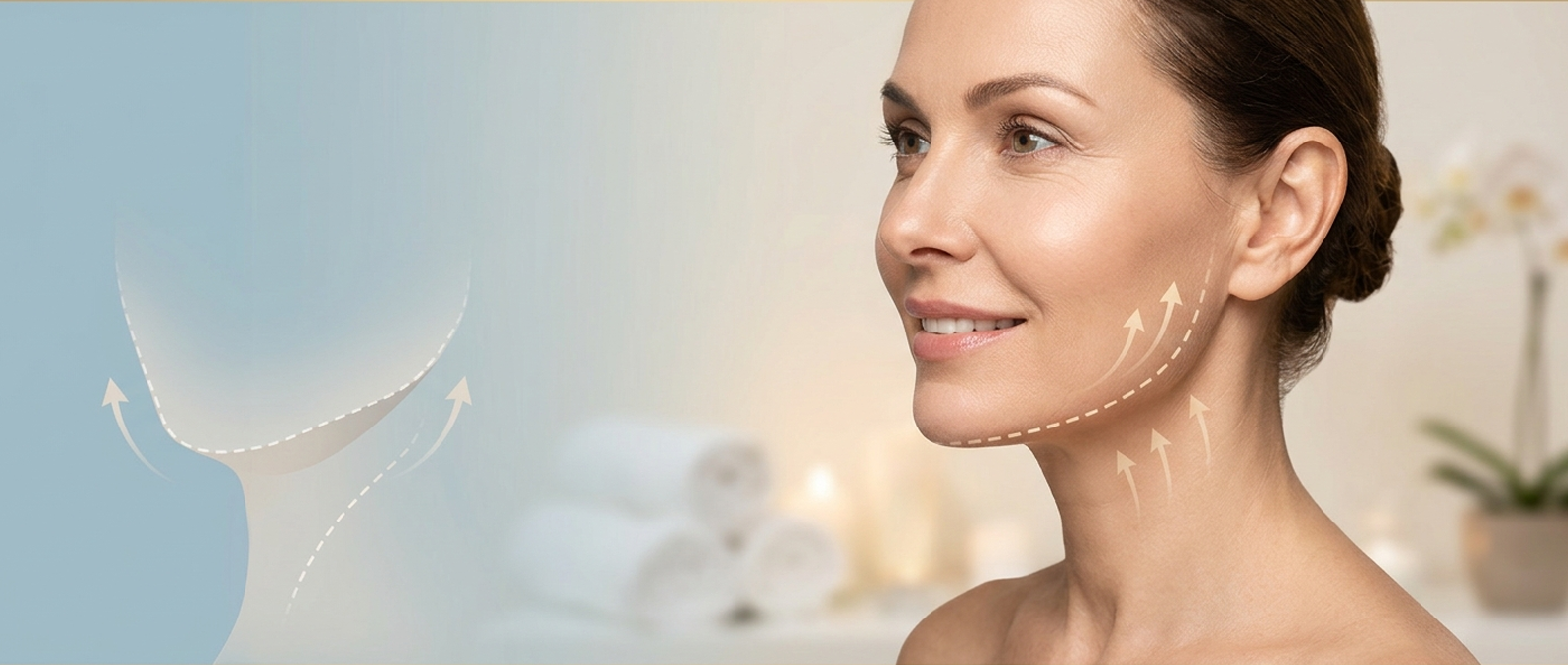
Non-Surgical Lower Face Tightening: Guide to Jawline & Jowl Rejuvenation
Gravity, time, and genetics — the lower face hides from none of them. While forehead lines and crow's feet tend to dominate anti-aging conversations, it's the lower third of the face — the jawline, jowls, chin, and neck — that often ages us the most. A softened jawline or sagging skin beneath the chin can quietly reshape how we look and, more importantly, how we feel about our reflection. The good news? Modern aesthetic medicine has evolved far beyond the classic facelift. Today, a spectrum of advanced, minimally invasive treatments can restore definition to the lower face without the long recoveries or telltale signs of "having had work done."
Let's explore what's driving lower face laxity, which cutting-edge treatments are delivering real results, and how to think about building a treatment plan that's tailored to you.
Why the Lower Face Ages Differently
The lower face is uniquely vulnerable to aging for several reasons. First, it's a zone of constant motion — talking, chewing, and expressing emotions place continuous mechanical stress on the skin and soft tissue around the mouth, chin, and jawline. Over time, this repetitive motion contributes to laxity and volume loss.
Second, the lower face is heavily influenced by bone resorption. As we age, the mandible (jawbone) gradually loses volume and projection. This creates a domino effect: with less skeletal support, the overlying fat pads shift downward, the skin begins to drape, and the once-crisp jawline gives way to jowling and a less defined chin.
Third, collagen and elastin production declines steadily after our mid-twenties. These structural proteins are the scaffolding that keeps skin firm and elastic. When their production slows, the skin's ability to "bounce back" diminishes — and the lower face, subject to gravity's constant pull, shows it first.
Understanding these layered causes is essential because no single treatment addresses them all. The most effective strategies combine modalities that work at different tissue depths: skin, fat, muscle, and bone.
The Modern Toolkit: Advanced Treatments for Lower Face Tightening
1. Dermal Fillers for Structural Restoration
Hyaluronic acid (HA) fillers and biostimulatory fillers have become foundational in lower face rejuvenation — but the approach has shifted dramatically. Rather than simply "filling lines," experienced practitioners now use fillers architecturally, restoring lost volume at the skeletal level to recreate the support structures that aging has diminished.
Jawline contouring with firm HA fillers can rebuild a sharp, defined mandibular border. Chin augmentation with filler adds forward projection, which in turn tightens the appearance of submental (under-chin) skin. This structural approach produces a lifting effect without any actual lifting — it's about rebuilding the foundation.
Biostimulatory fillers like poly-L-lactic acid (PLLA) and calcium hydroxylapatite (CaHA) go a step further by stimulating the body's own collagen production over time. These are particularly effective for patients with diffuse laxity across the lower face and neck, where the goal isn't just immediate volume but gradual, progressive skin tightening.
2. Thread Lifts: The Minimally Invasive Lift
PDO (polydioxanone) threads and newer absorbable thread technologies have matured considerably. Modern thread lifts use barbed or cogged sutures inserted beneath the skin to physically reposition sagging tissue along the jawline and jowl area. The threads provide an immediate mechanical lift, and as they dissolve over the following months, they trigger a collagen-remodeling response that extends the result.
Thread lifts are particularly well-suited for patients with mild-to-moderate jowling who aren't ready — or don't need — surgical intervention. Recovery is minimal, typically involving a few days of mild swelling and tenderness. Results generally last 12 to 18 months, making threads an excellent "bridge" treatment or a complement to fillers and skin-tightening devices.
It's worth noting that thread lifts require a highly skilled practitioner. Placement, thread selection, and vector planning (the direction of the lift) all directly impact the naturalness and longevity of the outcome.
3. Radiofrequency (RF) and Ultrasound-Based Skin Tightening

Energy-based devices have carved out a major role in lower face tightening, particularly for patients who want non-invasive, no-downtime options.
Microfocused ultrasound with visualization (MFU-V) — commonly known by its brand name — delivers focused ultrasound energy to the deep foundational layers of the skin (the SMAS layer), the same layer surgeons manipulate during a traditional facelift. This triggers a wound-healing response that gradually tightens and lifts tissue over two to three months.
Radiofrequency devices, both monopolar and bipolar, heat the deeper dermal layers to stimulate collagen contraction and neocollagenesis (new collagen formation). Newer RF technologies, including microneedling RF, combine the collagen-inducing benefits of controlled micro-injuries with the deep-heating action of radiofrequency, making them particularly effective for skin tightening along the jawline and upper neck.
These treatments are best suited for patients with mild laxity and good skin quality who want gradual improvement. They're also excellent maintenance treatments to prolong the results of fillers or threads.
4. Neuromodulators: The Subtle Refiner
Botulinum toxin — most commonly recognized by brand names in the aesthetic space — isn't just for forehead lines. In the lower face, strategically placed neuromodulator injections can:
- Slim a wide or square jaw by relaxing the masseter muscles, creating a more tapered, V-shaped lower face.
- Smooth dimpling or "cobblestoning" of the chin caused by an overactive mentalis muscle.
- Soften downturned mouth corners by relaxing the depressor anguli oris (DAO) muscles, which pull the corners of the mouth downward.
- Reduce platysmal bands in the neck — those vertical cords that become more prominent with age and muscle hyperactivity.
These are small-dose, precision treatments, but their cumulative effect on lower face harmony can be surprisingly significant.
5. Fat-Dissolving Injections
For patients whose lower face concerns include submental fullness — the stubborn pocket of fat beneath the chin often called a "double chin" — injectable fat-dissolving treatments offer a non-surgical solution. These injectables use synthetic deoxycholic acid, a molecule that naturally occurs in the body and helps break down dietary fat.
Administered over a series of sessions, fat-dissolving injections permanently destroy targeted fat cells, gradually refining the profile and enhancing jawline definition. This treatment pairs particularly well with skin-tightening modalities to prevent post-reduction laxity.
The Power of Combination Therapy
Here's where advanced aesthetics truly shines: the best lower face outcomes come from combining treatments. A skilled practitioner doesn't just pick one tool — they layer modalities to address each contributing factor simultaneously.
A typical combination protocol might look like this:
- Filler along the jawline and chin to restore structural support.
- Threads through the jowl area to mechanically lift and reposition descended tissue.
- Microneedling RF across the lower face and neck to tighten skin and boost collagen.
- Neuromodulator in the DAO and mentalis to refine expression-related concerns.
Treatments are often staged across several appointments, allowing each modality to settle and compound on the one before it. This layered approach is what separates a "done" look from a naturally refreshed one.
Choosing the Right Practitioner
Lower face aesthetics demand a deep understanding of facial anatomy. The lower third is rich in nerves, blood vessels, and muscle insertions, meaning imprecise treatment carries real risk — from asymmetry to nerve injury. When evaluating a practitioner, look for:
- Specialized training in facial anatomy and injectable techniques, ideally with board certification in dermatology, plastic surgery, or a related specialty.
- A portfolio of lower face work specifically, not just upper face or lip filler results.
- A consultative approach — the best providers will assess your bone structure, skin quality, fat distribution, and muscle activity before recommending a plan, rather than offering a one-size-fits-all menu.
Setting Realistic Expectations
Advanced aesthetics can produce remarkable improvements in lower face definition, but honesty matters. Non-surgical treatments work best for mild to moderate laxity. Patients with significant skin excess or advanced jowling may ultimately benefit most from surgical options — and a trustworthy practitioner will tell you that.
For most people, however, the sweet spot lies in starting earlier and maintaining consistently rather than waiting for dramatic changes and seeking a dramatic fix. Think of lower face treatments not as a single event, but as an ongoing investment in structural maintenance — much like fitness.
Final Thoughts
The lower face tells a story. When it's well-supported, defined, and proportionate, it communicates vitality and confidence — often more powerfully than any other part of the face. The evolution of minimally invasive aesthetics means that maintaining that definition is more accessible, more natural-looking, and safer than ever before.
The key is a thoughtful, anatomy-driven plan built by an experienced hand. Because when it comes to the lower face, precision isn't just preferred — it's everything.

Leave a comment
This site is protected by hCaptcha and the hCaptcha Privacy Policy and Terms of Service apply.