
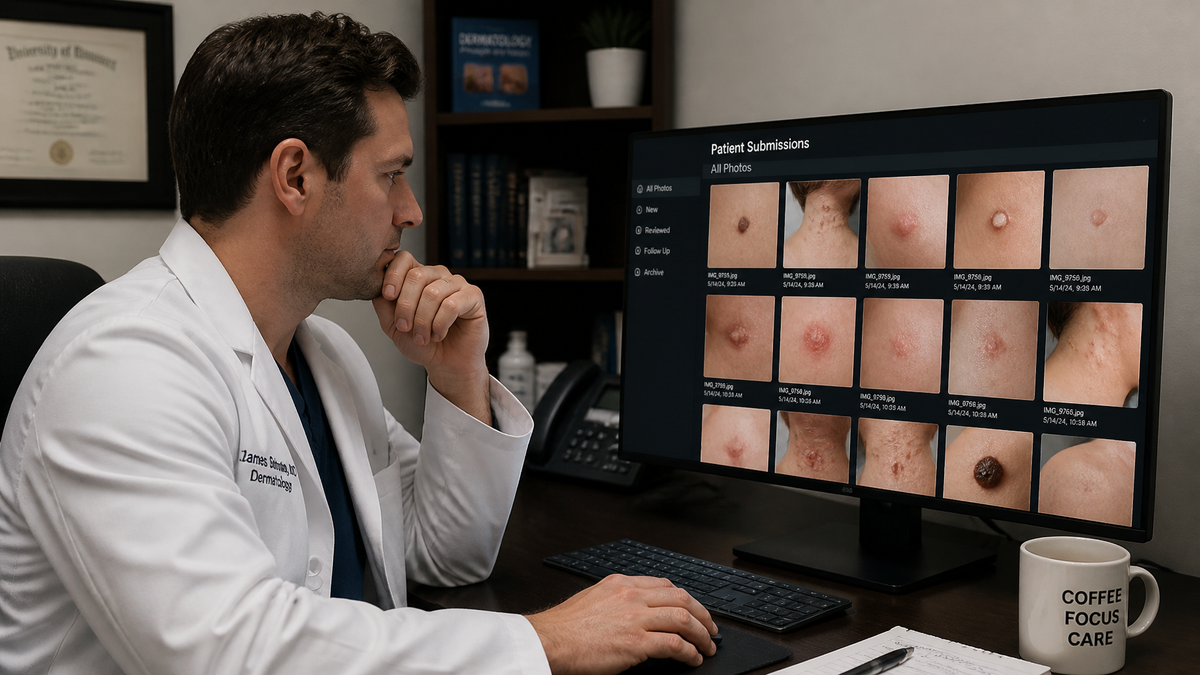
Is a Photo Consultation Right for You? How to Get an Expert Opinion Without Leaving Home
You have a rash that will not settle, a mole that has quietly changed shape, or a patch of skin that simply looks wrong. You have also got a job, a commute, a waiting list, and — depending on where you live — a specialist who is booked solid until next spring.
A photo consultation sits somewhere in the middle of that problem. It is not a diagnosis in the way a clinic appointment is a diagnosis. It is also not nothing, and it is certainly not the same as a search engine spiral at two in the morning. Below is an honest look at what a photo consultation can and cannot do, how to tell whether it suits your situation, and how to prepare one properly.
What a Photo Consultation Actually Is
A photo consultation — sometimes called teledermatology, an asynchronous skin consultation, or a remote second opinion — is a structured exchange in which you submit images of your skin and a description of your symptoms, and a qualified clinician reviews them and responds.
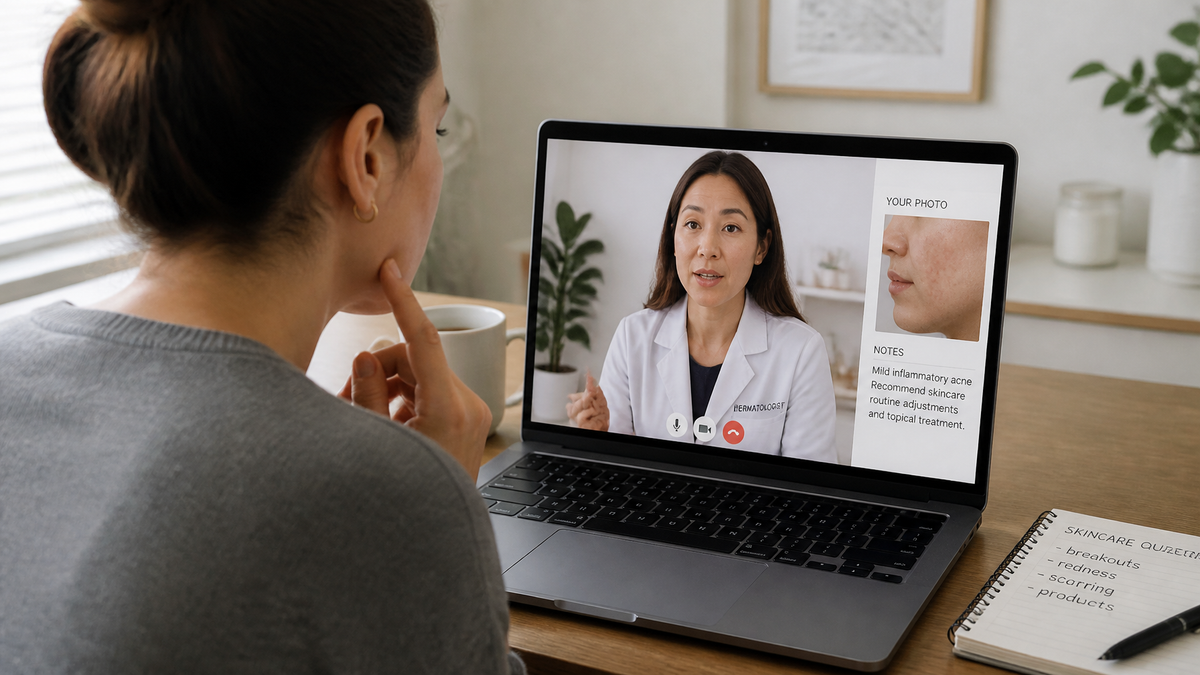
The distinguishing feature is that it is asynchronous. You are not sitting in a video call while a doctor angles a lamp at your arm and asks you to turn slightly to the left. You upload, they review, they write back.
That shift has real consequences. It removes geography from the equation, which matters enormously if the nearest dermatologist is a flight away. It removes waiting rooms and appointment slots from your week. It also removes touch, direct lighting, and the ability to ask a follow-up question in the moment, which is exactly where some of the clinical value of an in-person visit lives.
The Honest Limits
Most clinicians working in this space are careful about what they claim, and you should be too. The common thread in professional guidance is that image-based review is genuinely useful for some things and genuinely poor for others.
It tends to work reasonably well for:
- Assessing the general appearance and pattern of a rash
- Reviewing acne and its severity, including response to treatment
- Looking at eczema, psoriasis and other chronic conditions over time
- Following up on a condition already diagnosed in person
- Getting a second read on a lesion a clinician has already seen
It is weak or unsuitable for:
- Anything needing palpation — a lump you can feel but not see
- Lesions requiring dermoscopy, where a special magnifying instrument is used
- Conditions where the diagnosis depends on texture, temperature or depth
- Rapidly changing symptoms that need assessment within hours
- Anything involving mucosal surfaces or areas you cannot photograph clearly
There is also a well-documented phenomenon in remote review: poor image quality is the single biggest reason a consultation comes back inconclusive. A clinician who cannot see the border of a lesion cannot comment on the border of a lesion. No amount of clinical skill substitutes for a photograph that is blurred, badly lit, or taken at the wrong distance.
Is It Right for You? A Short Test
Photo consultation is probably a good fit if most of the following are true.
You have a skin concern that has been stable for days or weeks, not hours. You are comfortable with a written response rather than a conversation. Your concern is on an area you can photograph yourself, with or without a little help. You either cannot access a dermatologist conveniently, or you want an opinion before committing to a long wait. You understand that the outcome may be "this needs to be seen in person" — and you are willing to act on that.
It is probably the wrong choice if any of these apply.
The lesion is changing fast, bleeding, ulcerating or growing week on week. You have systemic symptoms alongside the skin problem — fever, joint pain, unexplained weight loss. You have a personal or family history of skin cancer and a new or altered lesion. You are seeking a definitive diagnosis you can rely on without any physical examination. Or you are, in truth, looking for reassurance rather than assessment.
That last one is worth pausing on. If what you actually want is to be told it is nothing, a photo consultation will not reliably give you that, and a clinician who offers you certainty from a photograph alone is not doing you a favour.
Red Flags That Need In-Person Care
Set the consultation aside and seek prompt in-person assessment if you notice any of the following:
- A mole or lesion that is asymmetric, has an irregular border, contains multiple colours, or is larger than about 6mm and changing
- A sore that has not healed after several weeks
- Bleeding, crusting or ulceration without an obvious cause
- A lesion that itches, hurts or has changed sensation
- Rapidly spreading redness, or redness accompanied by fever
- Swelling of the lips, tongue or throat, or any difficulty breathing
The last two are urgent. Do not photograph them. Get help.
How to Get a Useful Opinion
The quality of the answer you receive is largely determined before you ever submit anything. Preparation is the whole game.
Light it properly. Natural daylight, near a window, out of direct glare. Avoid overhead bulbs, which cast shadow and distort colour, and avoid flash, which flattens texture and blows out detail. Colour accuracy matters more than you might think — a clinician is reading hue as data.
Focus on the lesion, not the limb. Fill the frame. Use the tap-to-focus function on your phone and hold still for a moment after it locks. If your phone has a macro mode, this is what it is for.
Include a scale reference. A coin, a ruler or a tape measure beside the lesion gives the reviewer something to measure against. Size is one of the criteria clinicians use, and "about the size of a pea" is not a measurement.
Take several angles. Straight on, plus at least one oblique view. If the lesion is raised, a side-on shot showing its profile is genuinely informative.

Photograph the wider area too. One close-up and one wider shot showing where it sits on your body gives context that a tight crop removes.
Write a clear history. When did it appear? Has it changed, and how? Does it itch, hurt or bleed? What have you already tried, including over-the-counter products? What medications do you take? Any personal or family history of skin cancer or autoimmune conditions?
Do not edit the images. No filters, no cropping out surrounding skin, no colour correction. The unedited original is the clinical document.
Check the service. Is the reviewing clinician registered and licensed in your jurisdiction? Is there a clear policy on how your images are stored and how long they are kept? Will you receive a written report you can take to your own doctor? Look for these answers before you upload, not after.
Making the Most of the Response
When the opinion arrives, read it as a clinical document rather than a verdict.
Expect the clinician to offer a provisional impression, a set of possibilities ranked by likelihood, and a recommended next step. That next step may well be "see someone in person." Treat that as a useful result, not a wasted consultation — you have just been told what level of urgency to attach to the problem, which is often the hardest part to establish alone.
If the response recommends an in-person review, act on it. If it offers treatment suggestions, note that many jurisdictions restrict what a remote clinician can prescribe, and prescriptions for certain treatments may still require a physical examination. If the conclusion is unclear, ask whether it is unclear because of image quality — and if so, consider resubmitting with better photographs rather than concluding the whole approach does not work.
The Practical Verdict
A photo consultation is a good tool for a specific job: getting a qualified opinion quickly on a visible, stable skin concern, particularly when in-person access is slow, distant or expensive. It is a poor tool for anything urgent, anything requiring touch, and anything where you need certainty rather than an informed impression.
The sensible framing is this. Use it as a triage and access tool, not as a replacement for examination. It can tell you whether to worry, how quickly to act, and whether the thing you have been ignoring for three months deserves attention. It cannot tell you what a lesion feels like, and it cannot look beneath the surface.
If you are unsure which category you fall into, ask yourself one question: can this wait for a written reply? If yes, a photo consultation is a reasonable and often excellent first step. If no, skip it and get seen.


Leave a comment
This site is protected by hCaptcha and the hCaptcha Privacy Policy and Terms of Service apply.