
Article: Medical Skincare & Lasers: The Complete Science-Backed Guide
Medical Skincare & Lasers: The Complete Science-Backed Guide
Skin rarely changes overnight. It changes in the small, cumulative ways we treat it — and in recent years, two things have quietly rewritten what is possible: medical-grade skincare and modern laser technology. Together, they have turned "good skin" from a matter of luck and genetics into something far more systematic.
This article looks at how both work, who they suit, and what realistic results actually look like.
The shift from cosmetic to medical
The biggest change is philosophical. Skincare used to be about surface management: cleansers, moisturisers, a hopeful serum. Today, the most effective approaches are built on dermatological science — treating skin as living tissue with measurable structure, not just a surface to be polished.
That shift matters clinically. Skin is not a single sheet; it is a layered organ with distinct jobs. The outermost layer, the stratum corneum, is a brick-and-mortar barrier of flattened cells held together by lipids, and its health determines how much moisture you retain and how well you resist irritants. Beneath it sits the epidermis, where pigment-producing melanocytes live and where cell turnover happens. Deeper still is the dermis, the structural layer packed with collagen, elastin and hyaluronic acid — the scaffolding that gives skin its firmness and bounce.
Almost everything we call "ageing" is a change in one of those layers. Fine lines and thinning come from a dermis that produces roughly one per cent less collagen each year after our mid-twenties. Dullness comes from cell turnover slowing, so dead cells linger on the surface. Pigmentation comes from melanocytes behaving erratically after years of sun exposure. Redness comes from dilated capillaries near the surface.
Once you see skin this way, the logic of treatment becomes obvious. A well-formulated medical skincare routine can influence collagen production, pigmentation pathways and barrier function at a cellular level. Lasers can do something skincare alone cannot: deliver controlled, targeted energy deep into the dermis to trigger genuine structural change. Neither is a substitute for the other, and the most impressive results come from using both with intent.
What modern lasers actually do
Older laser treatments had a reputation for being harsh — long downtime, unpredictable results, a genuine risk of scarring or pigmentation changes on darker skin tones. Much of that has been engineered away.
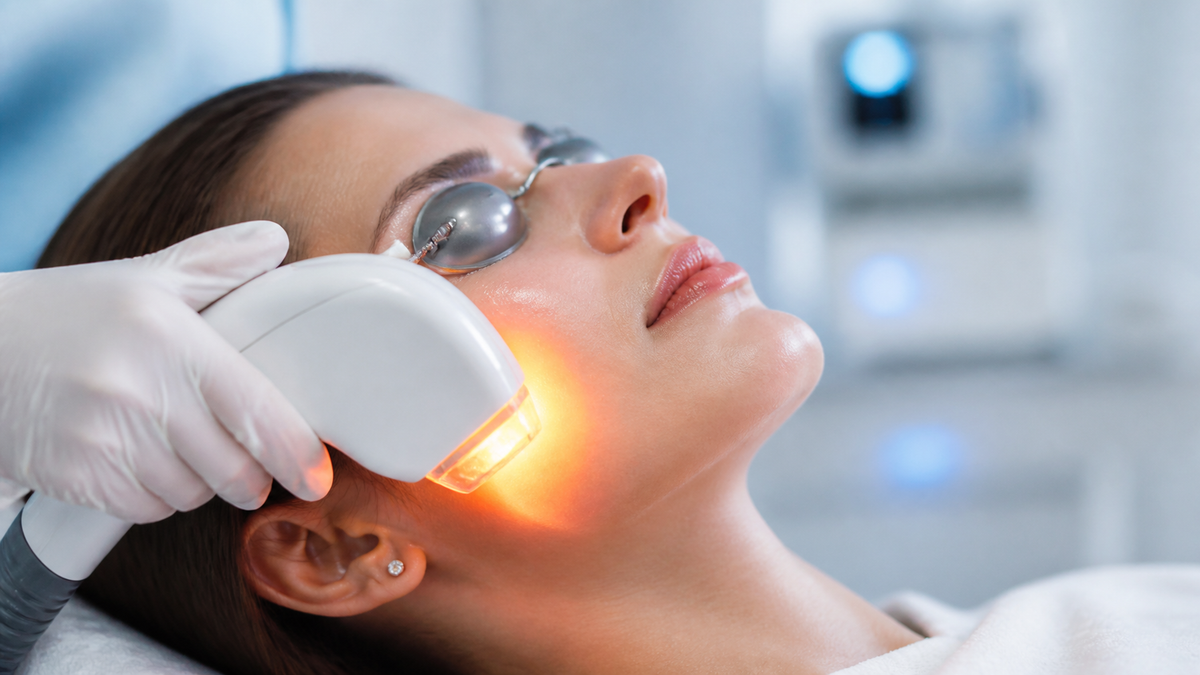
Fractional resurfacing treats only a fraction of the skin at a time, leaving surrounding tissue intact to speed healing. You get meaningful collagen remodelling with days rather than weeks of recovery. Picosecond lasers pulse in trillionths of a second, shattering pigment particles so finely that the body clears them easily — highly effective for melasma, sun damage and tattoo removal. Non-ablative lasers heat the dermis without removing the surface, making them ideal for early laxity and fine lines with almost no downtime. Vascular lasers target haemoglobin specifically, clearing redness, broken capillaries and rosacea-related flushing.
There is also a second family worth knowing about, because it is often confused with lasers: intense pulsed light (IPL) and LED phototherapy. IPL is not a laser at all but a broad-spectrum light source filtered to hit pigment and vessels — excellent for diffuse sun damage and an even complexion, less precise for a single stubborn lesion. LED therapy is gentler still, used mainly to calm inflammation and support healing rather than to resurface anything. Neither is a lesser option; they simply answer different questions, and a good clinician will match the device to the problem rather than the other way round.
Crucially, newer devices and protocols are far safer across a wider range of skin tones. This is not a small point. For years, people with deeper skin tones were told lasers "weren't for them." That advice is now largely obsolete, provided the treatment is delivered by someone who knows what they are doing. The reason it was ever given is that older devices could not distinguish between the pigment we want to target and the pigment that naturally sits in the surrounding skin, so the energy was absorbed indiscriminately. Longer wavelengths, shorter pulses and cooling mechanisms have changed that calculus considerably.
Why medical skincare is the other half
A laser without a proper skincare protocol is a missed opportunity. The laser creates the change; skincare maintains and extends it. Think of a laser session as a renovation and your daily routine as the maintenance that stops the building from reverting.
The staples of a medical-grade routine tend to be unglamorous but well-evidenced. Retinoids remain the gold standard for cell turnover and collagen stimulation. Vitamin C and other antioxidants reduce oxidative stress and support the brightening of uneven tone. Niacinamide strengthens the barrier and calms inflammation. Alpha hydroxy acids and salicylic acid handle texture and congestion. Broad-spectrum SPF 50 is non-negotiable — it is the single most effective anti-ageing product that exists, and the one most people under-apply.
The difference between this and a standard high-street routine is concentration, formulation quality and clinical rationale. A serum from a pharmacy shelf might contain a fraction of a per cent of an active, stabilised in a way that loses potency within weeks. A prescription-strength formulation can carry many times that, in a vehicle designed to penetrate rather than sit on the surface. The trade-off is real: stronger actives demand a period of adjustment, and going too fast is the most common reason people abandon a routine that would have worked.
Which specific actives you need depends on your skin, your goals and what you can tolerate — which is why a tailored prescription beats a generic "anti-ageing" set almost every time.
The results you can reasonably expect
Honesty matters here, because the internet is flooded with exaggerated claims.
Lasers can meaningfully improve: sun damage and pigmentation, acne scarring, fine lines and wrinkles, skin laxity, redness and visible pores, and overall texture. Medical skincare can improve: tone evenness, barrier resilience, breakout frequency, hydration, and the long-term trajectory of your skin.
What neither does is deliver someone else's face. Results are gradual, cumulative and best assessed at three to six months. Most people need a course of treatments rather than one session, followed by sensible maintenance.

It helps to know the timeline. In the days after a fractional treatment you will look worse before you look better — redness, mild swelling and a sandpaper texture are normal and expected. Around the second week, the surface settles and you notice a brightness that was not there before. The deeper collagen changes take longer, typically showing between the third and sixth month, which is why a single session is a poor test of whether a treatment "worked." Skincare follows a similar curve: barrier improvements in weeks, pigment changes over a couple of months, and structural changes over a year or more.
Combining the two
The most effective protocols sequence skincare and lasers deliberately. Often this means priming the skin for weeks beforehand with retinoids and pigment inhibitors, treating with the appropriate laser, then supporting recovery with barrier repair and strict sun protection. Getting this sequence right is what separates excellent outcomes from mediocre ones.
The preparation phase is not box-ticking. Priming with a retinoid thins the stratum corneum and speeds turnover, which lets laser energy reach its target more predictably and shortens healing. Adding a pigment inhibitor beforehand reduces the risk of post-inflammatory hyperpigmentation, particularly on deeper skin tones. Afterwards, a stripped-back routine of gentle cleansing, occlusive moisturiser and daily sunscreen protects the result while the skin rebuilds.
Some actives need to be paused entirely around treatment — certain acids and prescription retinoids among them — and your clinician will tell you exactly what to stop and when. Skipping that instruction is one of the few ways to genuinely harm your outcome.
Safety and choosing a practitioner
This is the part worth reading twice.
Laser treatments are medical procedures. They should be performed by a qualified doctor, dermatologist or clinician working under proper medical supervision, using equipment appropriate for your skin type. The consultation matters as much as the treatment: your Fitzpatrick skin type, medical history, medications and pigment tendencies should all shape the plan.
A few red flags: no consultation before treatment, promises of guaranteed results, no discussion of downtime or risks, and anyone willing to laser active infections, cold sores or recent sun exposure. Reasonable practitioners will sometimes decline to treat you — that is a good sign, not a bad one.
It is also worth asking what happens afterwards. A clinic that offers no follow-up, no way to reach anyone if your skin reacts badly, and no advice on aftercare has told you something about how it views its patients.
The bigger picture
Modern skin treatments reward consistency over intensity. A considered medical skincare routine used daily, punctuated by well-chosen laser sessions a few times a year, now outperforms almost anything else available.
The technology is genuinely impressive. But the transformation people notice — clearer tone, firmer texture, healthy glow — comes from the discipline around it: protecting your barrier, wearing sunscreen every day, and working with someone who understands your skin rather than just your budget.
Start with a proper assessment. Everything else follows from there.

Leave a comment
This site is protected by hCaptcha and the hCaptcha Privacy Policy and Terms of Service apply.