
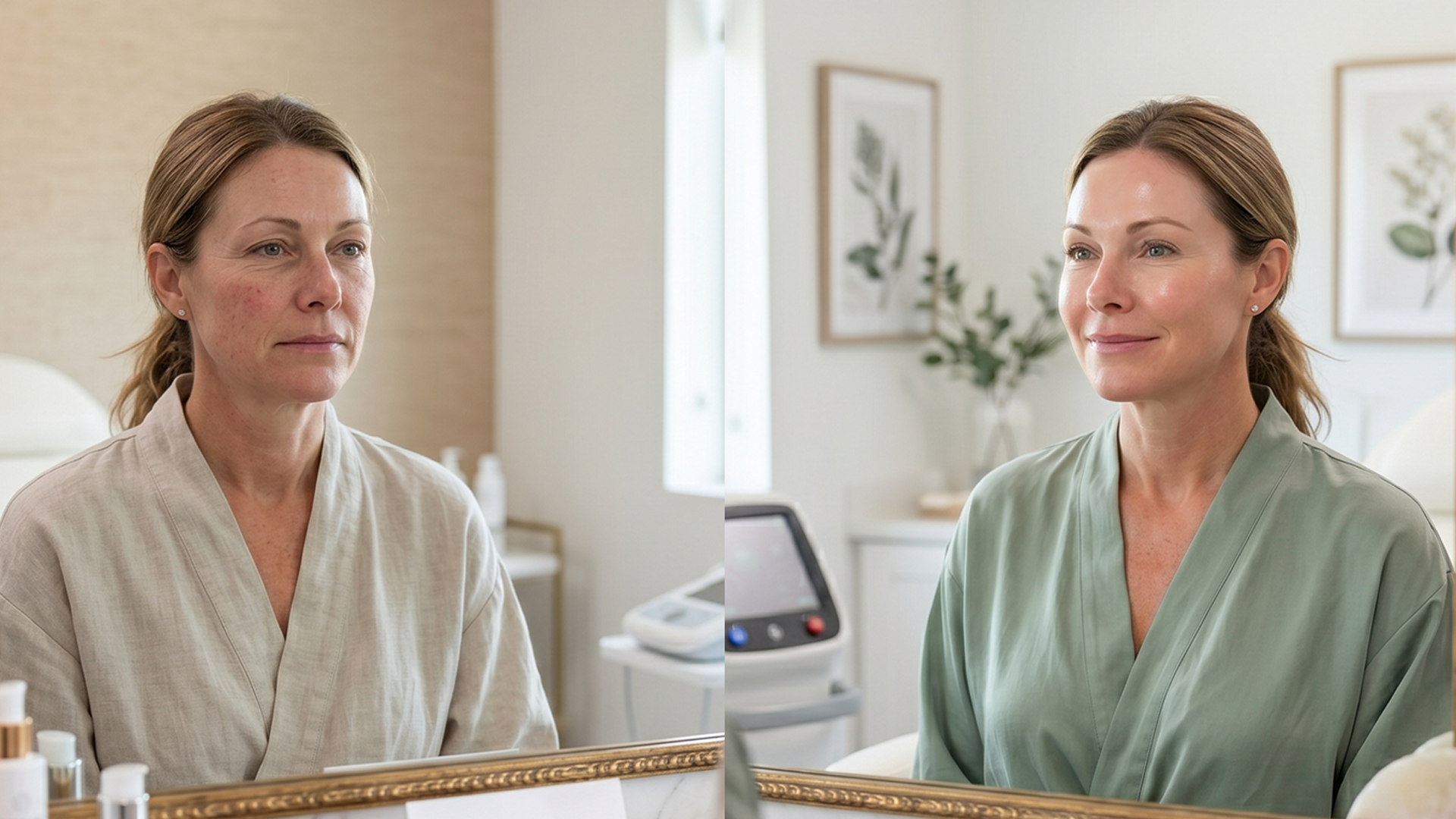
How Vascular Lasers Reduce Redness and Broken Capillaries
Vascular lasers represent a pinnacle of medical engineering, specifically designed to address one of the most common cosmetic and dermatological concerns: unwanted redness. Whether manifesting as the persistent flush of rosacea, the fine "spider webs" of telangiectasia (broken capillaries), or localised vascular lesions like cherry angiomas, these concerns are rooted in the circulatory system.
To understand how these lasers work, one must dive into the physics of light, the biology of the skin, and the concept of Selective Photothermolysis.
1. The Anatomy of Redness: What Are We Treating?
Before exploring the solution, we must define the problem. Facial redness and "broken" capillaries aren't actually broken; they are dilated.
-
Telangiectasia: These are small, widened blood vessels on the skin's surface. They are often caused by sun damage, aging, or genetics. Because the vessel walls have lost their elasticity, they remain permanently open and visible.
-
Rosacea: A chronic inflammatory condition where blood vessels hyper-react to triggers (spicy food, alcohol, heat), leading to a persistent "butterfly" flush across the cheeks and nose.
-
Hemangiomas and Port-Wine Stains: These are denser collections of abnormal blood vessels that appear as bright red bumps or deep purple patches.
The challenge for dermatology was historically how to destroy these vessels without burning the surrounding skin. The answer lies in the target.
2. The Science of Selective Photothermolysis
The "magic" of vascular lasers is governed by the principle of Selective Photothermolysis. This theory, pioneered in the 1980s, dictates that a specific wavelength of light can be used to target a specific "chromophore" (color-bearing substance) without damaging neighboring tissue.
In the case of vascular treatments, the chromophore is oxyhemoglobin, the protein in red blood cells that carries oxygen.
The Mechanism of Action
-
Absorption: The laser emits a concentrated beam of light at a wavelength that is highly absorbed by red pigments but poorly absorbed by the surrounding skin cells (melanocytes or water).
-
Conversion: As the hemoglobin absorbs this light energy, it instantly converts it into thermal energy (heat).
-
Coagulation: The heat causes the blood within the vessel to coagulate and the vessel walls to collapse. This is often referred to as "sealing" the vessel.
-
Resorption: Once the vessel is collapsed and blood no longer flows through it, it becomes waste tissue. Over the following weeks, the body’s lymphatic system naturally breaks down and reabsorbs the debris.
3. Types of Vascular Lasers and Devices
Not all "redness" is the same depth or shade, which is why different technologies are employed.
A. Pulsed Dye Laser (PDL) - The Gold Standard
The PDL (like the VBeam) typically operates at a wavelength of 595 nm. This wavelength is the "sweet spot" for bright red vessels. It is exceptionally safe for superficial redness and is even used on infants to treat port-wine stains. It uses a liquid dye as its medium and delivers energy in short bursts or "pulses."
B. Nd:YAG Laser
For deeper, bluish vessels (like those found on the legs) or thicker vascular lesions, the 1064 nm Nd:YAG is used. This longer wavelength penetrates deeper into the dermis. While it is less "selective" for red than the PDL, its depth makes it indispensable for larger vessels.
C. Intense Pulsed Light (IPL)
While technically not a laser (it uses a broad spectrum of light rather than a single wavelength), IPL is a staple for generaliSed redness. It acts like a "shotgun" approach, treating redness, brown spots, and texture simultaneously. It is ideal for patients with mild rosacea and "sun-damaged" complexions.
4. Recovery and Results: What to Expect
The disappearance of a capillary can sometimes be instant (the vessel "ghosts" or turns grey and vanishes), but for generalized redness, the process is gradual.
The Immediate Aftermath
-
Erythema (Redness): The treated area will look flushed for 24–48 hours, similar to a mild sunburn.
-
Edema (Swelling): Especially when treating areas around the eyes, mild swelling is common for a few days.
-
Purpura (Bruising): With older PDL settings, bruising was common. Modern "sub-purpuric" settings minimize this, though some stubborn vessels may still require a "bruising" dose for full clearance.
The Timeline of Improvement
-
Week 1: The initial redness fades.
-
Weeks 2-4: The body begins the "cleanup" phase, reabsorbing the treated vessels.
-
The "Rule of Three": While some see results in one session, most dermatologists recommend a series of 3 sessions spaced 4 weeks apart for optimal clearance of chronic redness or rosacea.
5. Safety, Risks, and Contraindications
Vascular lasers are remarkably safe when operated by trained professionals, but they are not universal.
-
Skin Type Matters: Because these lasers target pigment, patients with very dark skin tones (Fitzpatrick IV-VI) must be treated with extreme caution. The laser may struggle to distinguish between the red of the blood and the brown of the skin's melanin, risking burns or hyperpigmentation. In these cases, the Nd:YAG is often the safer choice.
-
Sun Exposure: Patients must avoid the sun for at least 2 weeks before and after treatment. A tan increases the melanin in the skin, which can "distract" the laser and cause a surface burn.
-
Medications: Photosensitizing medications (like certain antibiotics or Accutane) may require the treatment to be postponed.
6. Conclusion: A Clearer Path Forward
Vascular lasers have revolutioniSed the way we approach skin health. For those struggling with the self-consciousness of a red nose, the "flushing" of rosacea, or the ageing appearance of broken capillaries, these devices offer more than just a cosmetic fix, they offer a restoration of the skin’s natural tone and a significant boost in confidence.
By leveraging the laws of physics to target the blood without harming the skin, vascular lasers remain the most effective, evidence-based solution for vascular concerns in modern dermatology.


Leave a comment
This site is protected by hCaptcha and the hCaptcha Privacy Policy and Terms of Service apply.