
Article: Expert Skin Advice from Home: Who Benefits Most from Virtual Consultations?
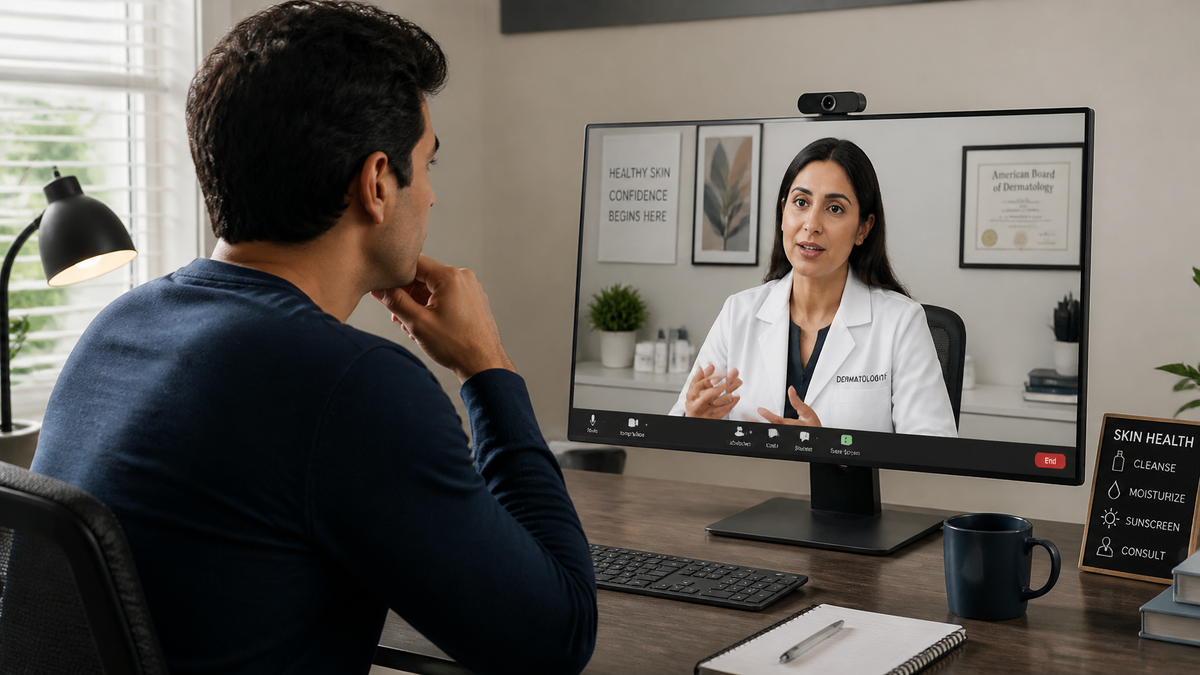
Expert Skin Advice from Home: Who Benefits Most from Virtual Consultations?
Dermatology has always had a waiting-list problem. In the UK, a referral for a stubborn patch of eczema or a cluster of breakouts can mean months before you sit opposite a specialist — and months more before a treatment plan actually settles. Virtual consultations have changed that arithmetic. A video call, a secure photo upload and a short questionnaire now stand where a referral letter used to.
But a virtual consultation is not simply a cheaper, faster version of an in-person appointment. It is a different instrument, and like any instrument it suits some jobs better than others. Here is an honest look at who benefits most — and where the format reaches its limits.
Why the format works at all
Dermatology is unusually well suited to being assessed on a screen. It is a visual specialty: much of the diagnostic work happens by looking. High-resolution images, good lighting and a structured history can carry a great deal of that information, and in several areas the evidence supports remote assessment as genuinely comparable to being seen face-to-face.
The format's real advantages are practical ones. You are seen sooner. You are seen in your own environment, with your own products to hand, in the morning light your skin actually lives in. You can ask questions without feeling rushed, and you can revisit the advice afterwards rather than trying to remember it in a car park.
Who tends to benefit most
People with chronic, manageable conditions. Acne, rosacea, eczema, psoriasis, melasma and seborrhoeic dermatitis are long-term companions. They flare, settle, and flare again, and each shift may need a tweak rather than a fresh diagnosis. That makes them ideal for virtual follow-up: a review appointment conducted from home is easy to attend, easy to repeat, and often enough to adjust a routine without a trip across the country.
People with mobility, health or caring constraints. If travelling is painful, exhausting or logistically complicated — or if you are the person everyone else depends on — a consultation that happens from your kitchen table is not a convenience. It is the difference between being seen and not being seen.
People in areas with thin specialist provision. Rural and remote communities, and places where the local dermatology waiting list runs into many months, gain disproportionately. So do people who need a specialist opinion in a language or cultural context they find easier to navigate remotely.
People who work unpredictable hours. Shift workers, freelancers and parents of small children often cannot take an afternoon off. Evening and weekend slots, plus the ability to join from work, widen access considerably.
People managing maintenance rather than mystery. If your diagnosis is settled and the question is "is this routine still right for me?", remote review is often the most efficient possible appointment. It is also well suited to reviewing the products you already own — the ones sitting half-used on a shelf — rather than prescribing from scratch.
Where the format genuinely struggles
Being straight about this matters more than selling the convenience.
A virtual appointment cannot palpate. It cannot feel the thickness of a plaque, the firmness of a nodule, or the texture of a lesion that has changed. It cannot use a dermatoscope with the magnification and lighting a clinician controls in the room. It cannot examine the scalp under a lamp, check the inside of a mouth, or take a swab or a biopsy.
Where those things matter, in-person care is not optional. That includes:
- Anything suspected of being skin cancer. A new, changing, bleeding, crusting or non-healing lesion needs a physical examination, and often dermoscopy. Do not wait for a video slot.
- Rapidly spreading rashes with systemic symptoms — fever, joint pain, blistering — which need urgent assessment, not a photo upload.
- Conditions needing procedures — cryotherapy, biopsy, incision, laser, injections — which are inherently hands-on.
- Anything affecting the eyes, genitals, or mucous membranes, where examination is delicate and detail is easily lost on camera.
- Severe or unstable disease, where the risk of a missed or delayed diagnosis outweighs the convenience of remote care.
Video also introduces its own distortions. Colour reproduction varies wildly between cameras, so redness, pigmentation and bruising can all be misread. Compression, white balance and screen settings shift what a clinician sees. Poor lighting flattens texture. In short, the format is only as good as the images you provide.
Getting the most from a remote appointment
A handful of habits make a measurable difference.
Photograph in daylight, near a window, facing the light. Avoid harsh overhead bulbs and avoid flash, which flattens and over-brightens. Take one wide shot for context and then close-ups: one straight on, one from each side. Include a coin or ruler for scale. Take several images on different days so change is visible.
Resist the urge to clean up. Do not apply make-up, tinted moisturiser or filters over the area. Do not exfoliate or apply a new active the night before — arrive with your skin as it normally is. If you use prescription treatments, bring them to the camera so their names and strengths are legible.
Write your history down. When did it start? What makes it worse? What have you already tried, for how long, and what happened? What else is going on — medicines, hormones, stress, diet, sleep, family history? Skin rarely behaves in isolation.
Photograph your current products, front and back, including ingredient lists. A clinician can then assess what you are using rather than guessing from brand names, which matters because the same brand can carry very different formulations.
Come with specific questions. Remote appointments reward precision. "What is this?" is harder to answer from a photograph than "This has been itchy and scaly for six weeks, worse at night, and a mild steroid helped for a fortnight then stopped working — what should I try next?"
The honest conclusion
Virtual dermatology is not a lesser version of the real thing. It is a specific tool that happens to be excellent at long-term management, follow-up, access and convenience — and genuinely poor at anything requiring touch, magnification or urgency.
The people who benefit most are those with chronic conditions needing regular adjustment, those for whom travel is a barrier, and those whose skin is stable enough to be meaningfully assessed from a good photograph. The people who should go straight to a clinic are those with a changing lesion, a rapidly worsening rash, or a problem needing a procedure.
If you are unsure which group you fall into, err towards being seen. And if you are booking remotely, treat the appointment as you would a professional photo shoot: good light, honest skin, clear information, no filters. That is where remote care works best — and where it can be genuinely excellent.


Leave a comment
This site is protected by hCaptcha and the hCaptcha Privacy Policy and Terms of Service apply.