

Is a Photo Consultation Right for You? How We Evaluate Skin Conditions Remotely
Skin complaints are among the most common reasons people seek medical advice, and they are also among the most visual. A rash, a mole, a patch of scaling skin — these are things you can see, photograph and send. That has opened up a genuinely useful option: the photo consultation, where a clinician assesses your skin from images and a written history rather than from an in-person examination.
It is not right for everyone, and it is not right for every problem. But for a great many people it is faster, cheaper and more convenient than waiting weeks for an appointment. Here is an honest look at how remote skin assessment works, where it excels, and when you should put the phone down and go and be seen in person.
What a photo consultation actually is
A photo consultation is a structured remote assessment. You submit images of the affected area along with a description of your symptoms, your history and any relevant medication. A qualified clinician reviews both the pictures and the text, then offers an assessment, a management plan, or a recommendation to be seen face to face.
It is not a chatbot guessing at your rash. It is not a substitute for a biopsy or a dermoscopic examination under magnification. It sits somewhere between "asking a friend" and "sitting in a dermatology clinic" — far closer to the latter when the images are good and the problem is straightforward.
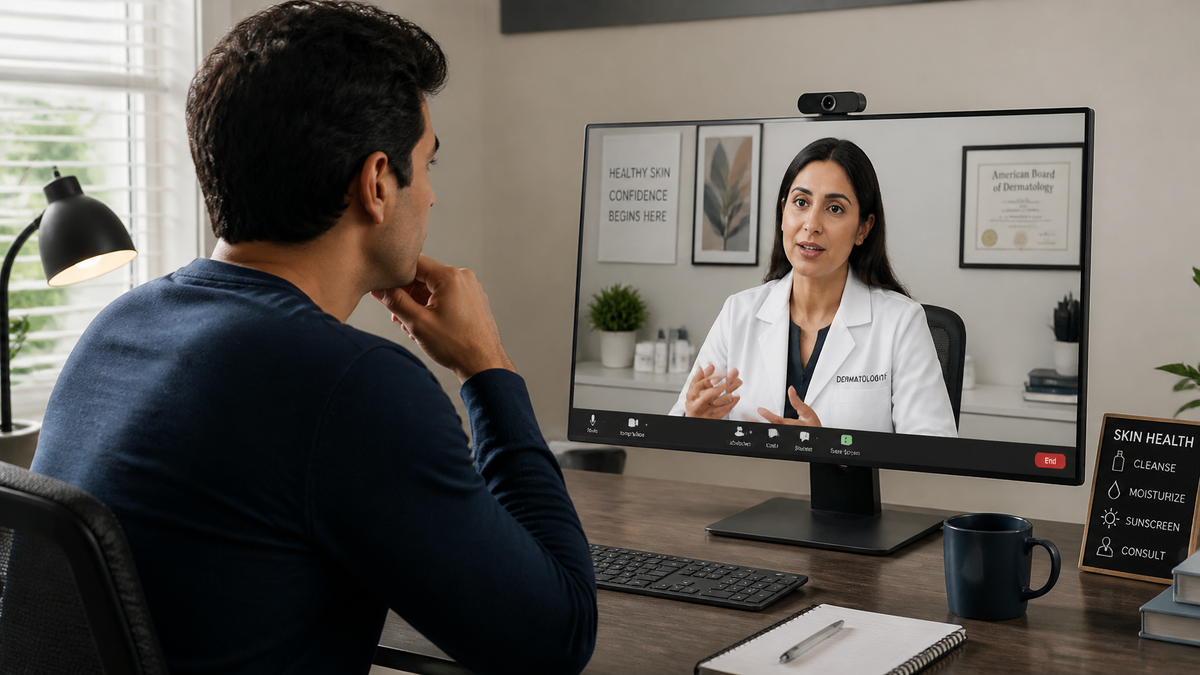
The format varies. Some services use asynchronous review, where you upload and receive an answer within a day or two. Others use video, which combines a live conversation with the option to hold a phone camera up to the skin. Both have their place.
The technology is only half the story
Good remote assessment depends on two things: a clear image and an accurate history. Clinicians are surprisingly good at working from a well-lit photograph, but they cannot assess what they cannot see.
Getting the photograph right
Most rejected or delayed assessments come down to image quality rather than clinical complexity. A few habits transform results:
- Use natural daylight. Stand near a window, or step outside on an overcast day. Avoid direct sun, which blows out colour, and avoid warm indoor bulbs, which shift everything orange.
- Do not use flash. It flattens texture and creates hotspots that hide the very detail a clinician needs.
- Include a scale reference. A coin, a ruler or a tape measure beside the lesion tells the reviewer the actual size.
- Take three shots. One from about 20–30 cm away showing the affected area in context, one close-up filling the frame, and one from a slight angle to show whether the lesion is raised.
- Keep it sharp. Brace your elbows, tap to focus, and take several frames rather than one.
- Shoot the whole area too. If you have spots scattered across your back or both arms, a wider shot showing the distribution matters as much as the close-up.
One practical tip: photograph skin you are not worried about as well, in the same lighting. That gives the reviewer a baseline for your normal skin tone and texture.
The history matters just as much
Images tell a clinician what a lesion looks like right now. Your description tells them what it is doing. Useful things to include:
- When it started, and whether it appeared suddenly or gradually
- Whether it itches, burns, hurts or is numb
- Whether it is spreading, stable or fading
- Anything that makes it better or worse
- Previous treatments tried, and whether they helped
- Your medical history, including skin cancer, eczema, psoriasis or autoimmune conditions
- Current medication, including anything new in the weeks before the problem started
- Relevant family history — particularly melanoma
- Occupation, hobbies and travel, where these could be relevant
Write it in plain language. You do not need medical vocabulary; you need accuracy and honesty, including about things you might feel embarrassed by.
Where photo consultations work well
Remote assessment is a strong fit for a range of common problems:
Acne and rosacea. These are typically diagnosed on appearance and history. Follow-up reviews of an ongoing treatment plan work particularly well remotely — you can track change over weeks with repeat photographs.
Eczema and dermatitis. Flare-ups, trigger identification and emollient or steroid plans can often be managed without an examination, provided the distribution and appearance are clear.
Psoriasis. Plaque psoriasis has a distinctive appearance, and remote review is well suited to monitoring severity and response to treatment.
Fungal infections. Ringworm, athlete's foot and similar conditions are frequently recognisable from a good photograph, though some cases need scrapings to confirm.
Cold sores, shingles and other viral rashes. Timing and distribution are often as diagnostic as the individual lesion.
Minor skin injuries and infections. Small cuts, insect bites and mild localised infection can frequently be assessed remotely, with clear red-flag advice about when to attend in person.
Follow-up and monitoring. If you have already been diagnosed, remote review is often the most sensible way to check progress, adjust treatment or decide whether you need to be seen again.
Second opinions. Sending images to a different clinician can be a quick way of getting another perspective on a lesion you are unsure about.
Where it falls short
Honesty matters here more than enthusiasm. Remote assessment has real limits.

Suspected melanoma or any changing mole. This is the big one. Pigmented lesions need dermoscopy — examination with a magnifying instrument — and often need to be felt. Some need excising. A photograph can raise or lower suspicion, but it cannot rule out skin cancer. If a mole is new, changing in size, shape or colour, itching, bleeding or crusting, do not rely on a photo consultation. Book an in-person appointment.
Anything that needs to be touched. Texture, temperature, firmness, mobility of a lump, whether a lesion is fixed to deeper tissue — these are all palpation findings. A picture cannot supply them.
Conditions requiring tests. Patch testing for contact allergy, skin scrapings, swabs, blood tests and biopsies all require attendance.
Widespread or severe disease. If a large proportion of your body is affected, if you feel systemically unwell, or if the problem is causing significant pain or distress, you need an examination.
Urgent problems. Severe allergic reactions, rapidly spreading infection with fever, blistering conditions or any difficulty breathing need emergency care, not a photograph.
Certain anatomical sites. Genital, anal, breast and scalp lesions are often better examined in person, both for technical reasons and because they may warrant specific tests.
When you cannot get a usable image. Very dark skin tones, very fair skin, hair-covered areas, or lesions inside the mouth or nose can be difficult to capture adequately. A clinician may reasonably decline to assess remotely and ask you to attend.
Practical questions before you book
A few sensible checks will tell you whether a service is worth your time:
Who is reviewing? A consultant dermatologist, a dermatology nurse specialist, a general practitioner with a skin interest — these are different levels of expertise. The service should tell you clearly.
What is the turnaround time? If you need an answer today, an asynchronous service promising a reply in five days is not the right tool.
What happens if the reviewer wants to see you? Good services have a clear pathway to in-person referral. Be wary of any that do not.
What is the follow-up arrangement? Can you ask a question afterwards, or is the interaction closed once the assessment is issued?
How is your data handled? Images of your skin are sensitive personal data. Check that the service is transparent about storage, security and retention.
What is the pricing model? Per-consultation, subscription, or insurance-funded — and what does it include?
Making the most of a remote review
If you decide to go ahead, a little preparation goes a long way. Take photographs in daylight on the day you submit, not ones from three months ago. Write your history before you start the form, so you do not forget the detail that matters. List your medications by name and dose. Note the dates things changed.
Then read the response carefully. A good remote assessment does not just name the condition — it tells you what to do next, what to watch for, and the specific circumstances in which you should seek in-person care. If your plan does not include that last part, ask for it.
And if the reviewer recommends you come in, treat that as useful information rather than a failure of the process. Knowing which problems need a clinic is exactly what a competent remote service should be able to tell you.
The bottom line
A photo consultation is a legitimate, often excellent option for common, visible, stable skin problems — acne, eczema, psoriasis, fungal infections, minor injuries and follow-up reviews. Good photographs and a thorough history can give a clinician most of what they need, and the convenience is real.
It is the wrong choice for anything that might be skin cancer, anything that needs to be touched or tested, anything widespread, severe or urgent, and anything you simply cannot photograph well.
If you are unsure which side of that line your problem falls on, describe it honestly and let the reviewer decide. The right answer to "is a photo consultation right for me?" is sometimes no — and a service that tells you so is doing its job properly.


Leave a comment
This site is protected by hCaptcha and the hCaptcha Privacy Policy and Terms of Service apply.