
Article: Deep Hydration Defined: Why Vitamin B5 Gel Belongs in Your Skincare Routine
Deep Hydration Defined: Why Vitamin B5 Gel Belongs in Your Skincare Routine
Most of us believe we know what dehydrated skin feels like. It is tight after cleansing, flaky by mid-afternoon, and dull in photographs. So we reach for the richest cream on the shelf, layer it on generously, and wait. Sometimes it works. Often it does not, and the reason is that we have misdiagnosed the problem entirely. Dryness and dehydration are not the same thing, and treating one as though it were the other is why so many people spend years feeling perpetually parched despite an expensive routine. Understanding the distinction is the first genuinely useful thing you can do for your skin.
Dry Skin and Dehydrated Skin Are Not Synonyms
Dry skin is a skin type. It lacks oil — the lipids that sit in the upper layers and hold everything together. It tends to feel rough, look flaky, and stay that way regardless of the weather. Dehydrated skin is a condition, and it can affect anyone, including those with oily or combination skin. It lacks water. A person with a shiny T-zone can be dehydrated; a person with dry skin can be perfectly well hydrated. The two frequently overlap, which is precisely what makes the confusion so persistent.
The distinction matters because water and oil are lost through different mechanisms and replaced by different ingredients. A heavy occlusive cream will do very little for a skin barrier that is struggling to retain water. What that barrier needs is humectants — ingredients that attract water into the upper layers of the skin and hold it there — combined with the structural components that keep the barrier intact in the first place.
What Deep Hydration Actually Means
"Deep hydration" is one of the more abused phrases in skincare marketing, so it is worth defining properly. Water does not travel endlessly downwards into the dermis from a jar. What we call deep hydration is really about the stratum corneum — the outermost layer — functioning as it should. This layer is often described as a brick wall: skin cells are the bricks, and the mortar between them is a mixture of ceramides, cholesterol and fatty acids. When that mortar is compromised, water escapes through the skin at an accelerated rate, a process known as transepidermal water loss.
Deep hydration, then, has two halves. The first is replenishment: getting water-attracting molecules into the upper layers so they can bind moisture. The second is retention: supporting the barrier so the water stays where you put it. A hydrating product that does only the first half will feel wonderful for an hour and leave you exactly where you started by the evening. The ingredients that do both are the ones worth building a routine around.
Enter Vitamin B5

Vitamin B5 — pantothenic acid, and in skincare almost always in its more stable alcohol form, panthenol — is one of the quiet workhorses of cosmetic formulation. It is a small molecule, which means it penetrates the upper layers of the skin readily rather than sitting on the surface. Once there, it behaves as a humectant, drawing water into the stratum corneum and holding it in place. In that respect it is a relative of glycerin and hyaluronic acid, but it has a lighter, less tacky finish than either, which is why it appears so often in products designed for reactive or blemish-prone skin.
Panthenol also converts in the skin to pantothenic acid, a precursor of coenzyme A, which is involved in the normal metabolism and repair of skin cells. This is where the ingredient earns its reputation beyond simple hydration. It is widely used in post-procedural and wound-care formulations for its soothing, calming properties, and it is generally very well tolerated — an unusually forgiving ingredient for something that actually does something.
Why a Gel, Not a Cream
The delivery format is not incidental. A gel — particularly a water-based gel built on humectants rather than heavy oils — is absorbed quickly, sits weightlessly on the skin, and can be layered without the pilling and congestion that rich creams sometimes cause. For anyone who is oily, combination, living in a humid climate, wearing makeup, or simply averse to the feeling of product sitting on their face, a gel is the format that gets used consistently. And consistency, more than any single hero ingredient, is what produces visible change in skin.
Gels also make excellent layering tools. Applied to slightly damp skin after cleansing and before a moisturiser, a hydrating gel primes the skin and allows the occlusive layer that follows to seal in more water than it otherwise would. This is the essence of the widely recommended "hydrate then seal" approach, and it is the single most effective change most people can make to a routine that is not delivering results.
Where Vitamin B5 Gel Fits in a Routine
A well-constructed routine has a clear sequence: cleanse, treat, hydrate, protect. Vitamin B5 gel occupies the hydrate step, and it belongs there on most days, morning and evening. In the morning it goes on after any antioxidant serum and before sunscreen; in the evening, after any exfoliating or retinoid treatment and before your night moisturiser.
That placement matters for a practical reason. Vitamin B5's soothing properties make it a sensible buffer against actives that can leave skin feeling stripped or irritated, which is why it is often recommended to those introducing retinol or acids. Applied after a treatment, it calms; applied before a moisturiser, it holds water in. It is one of the few products in a routine that is genuinely doing two jobs at once.
There are, of course, no absolute rules. If your skin is very dry and you prefer a richer product at night, the gel can be reserved for mornings. If your skin is dehydrated but oily, it can effectively be your moisturiser for much of the year. The point is not to follow a diagram but to understand what the product is for, and then place it where your skin needs it.
Choosing Well
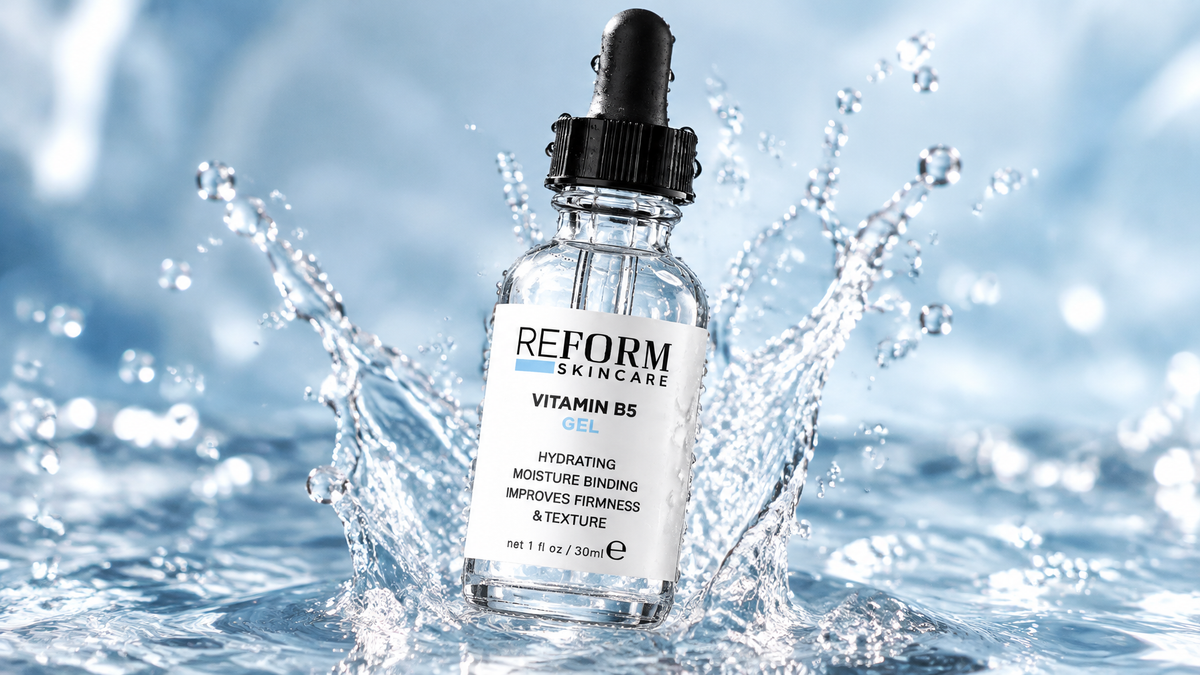
Not all vitamin B5 gels are equivalent, and the concentration and supporting cast are what separate a genuinely hydrating product from a pleasant, watery one. Reform Skincare's Vitamin B5 Gel is formulated as a fast-absorbing gel that replenishes hydration and supports the skin's natural barrier, leaving skin calm and balanced with daily use — which is exactly the profile of product described above: lightweight, humectant-led, and built around barrier support rather than surface shine. You can see the full formulation details and how it sits alongside their cleansers, serums and moisturisers at reformskincare.com.
When assessing any hydrating gel, look past the marketing and ask three questions. Does it lead with humectants — panthenol, glycerin, hyaluronic acid, betaine — rather than water and fragrance? Does it contain anything that supports the barrier, such as niacinamide or ceramides? And is the texture something you will actually want to apply twice a day for the next six months? If the answer to all three is yes, you have found a product worth keeping.
The Long View
Hydration is not a one-off fix but a daily discipline, and it responds to patience rather than intensity. Skin that is consistently hydrated looks plumper, because water-filled cells reflect light more evenly. Fine lines appear softer for the same reason. Makeup sits better. Actives cause less irritation. These are not dramatic transformations, but they accumulate.
The most sensible approach is to stop chasing richness and start thinking about balance — water in, water retained, barrier intact. Vitamin B5 gel is a quiet, well-tolerated, genuinely functional way to do the first half of that, and to support the second. It is not the most exciting product on your shelf. It may well be the one you notice missing when it runs out.


Leave a comment
This site is protected by hCaptcha and the hCaptcha Privacy Policy and Terms of Service apply.