
Article: 5 Signs It's Time to Get That Mole Checked (and Removed)
5 Signs It's Time to Get That Mole Checked (and Removed)
Most of us have a mole somewhere — a small brown smudge on the shoulder, a dark dot on the back, a freckle-like mark that has been there since childhood. For the overwhelming majority of people, these are nothing more than harmless clusters of pigment cells, quiet companions for life. But a small proportion of them can change, and that change is the earliest and most treatable warning sign of skin cancer.
Skin cancer is one of the most common cancers worldwide, and in countries like Australia, New Zealand and the UK, rates of melanoma have risen steadily over recent decades. The Philippines, with its intense year-round sun and large outdoor workforce, is far from exempt — a point worth remembering in a country where sun protection is often treated as a holiday concern rather than a daily habit. The good news is that melanoma, when caught early, is one of the most curable of all cancers. The bad news is that it rarely announces itself with pain or bleeding; it whispers, and it is easily missed.
This article walks through five signs that should send you to a doctor, explains what happens when you get there, and covers what removal actually involves — because the fear of the unknown is often worse than the procedure itself.
1. A Mole That Is Changing in Size, Shape or Colour
Change is the single most important thing to watch for. A mole that was once the size of a pinhead and is now noticeably larger, or one that has developed an irregular, jagged border where it used to be round, deserves attention. So does a mole that has taken on a different colour — becoming darker, patchy, or developing several shades of brown, black, red or even blue within the same spot.
Dermatologists often use a simple memory aid called the ABCDE rule to describe these changes: A for asymmetry, B for border irregularity, C for colour variation, D for diameter greater than about six millimetres, and E for evolution — any change over time. The last one, evolution, is arguably the most useful of all, which is why photographing your moles periodically can be genuinely valuable. A smartphone photo taken from a consistent distance and angle creates a baseline you can compare against months or years later. If a mole has visibly evolved since that photo was taken, that is your cue to book an appointment rather than wait and see.
2. A Mole That Itches, Bleeds or Doesn't Heal
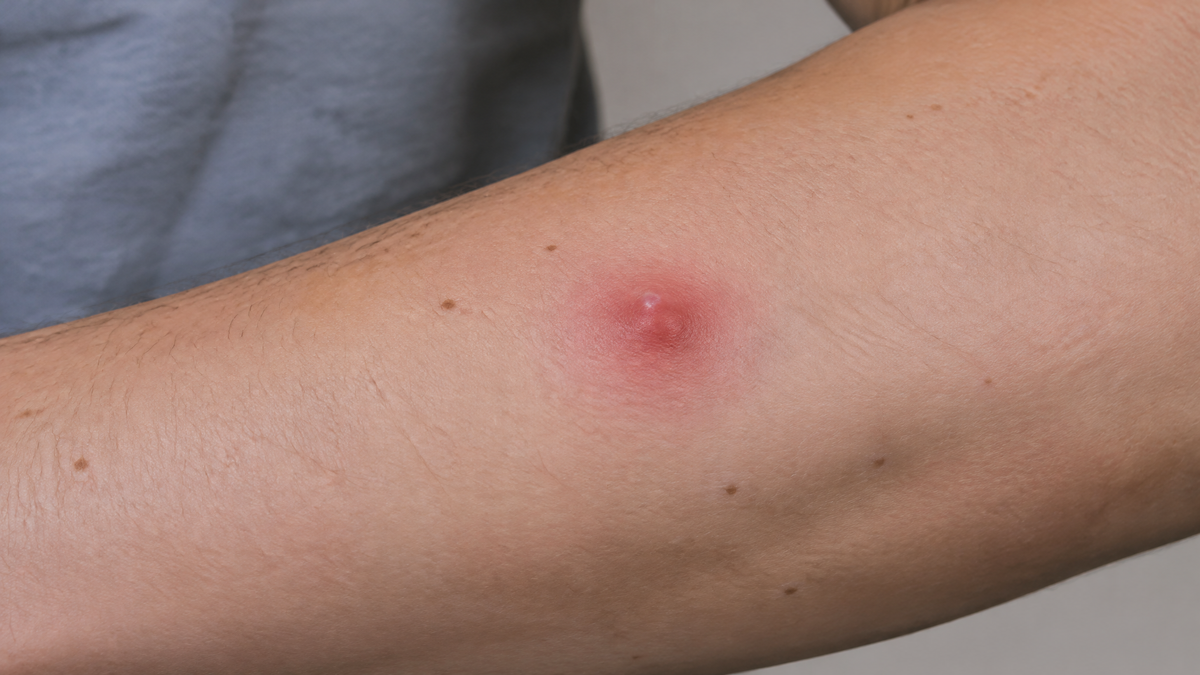
Ordinary moles do not itch, crust over, bleed spontaneously or develop a sore that refuses to heal. When any of these happen, the mole is telling you something. An itch that persists for weeks, a spot that scabs over and then scabs again, or a small lesion that bleeds when you brush against it with a towel — these are all reasons to get it examined promptly rather than treating it with a plaster and hoping for the best.
It is worth being clear that bleeding does not automatically mean cancer; moles can be irritated by clothing, shaving or friction. But an unexplained, recurring bleed or a wound that lingers beyond a few weeks is precisely the kind of ambiguity a doctor exists to resolve. Waiting three months to see whether it settles is a gamble with poor odds and no upside.
3. A New Mole Appearing After the Age of 30
New moles are entirely normal in children, teenagers and young adults — the body is still laying down pigment cells. After roughly the age of 30, however, the appearance of a genuinely new mole becomes less common and therefore more noteworthy. A new dark spot that emerges in adulthood, particularly one that grows quickly over weeks or months, warrants a professional look.
This is especially true for people with a family history of melanoma, those with many moles (more than 50 to 100), people with fair skin that burns easily, and anyone who has experienced severe sunburn in childhood. If you fall into one of these higher-risk groups, your threshold for seeking advice should be lower, not higher. A quick check that turns out to be nothing is a good outcome, not a wasted appointment.
4. A Mole on a Part of the Body You Rarely See
Moles on the back, scalp, behind the ears, between the toes, on the soles of the feet and under the fingernails and toenails are frequently discovered late, simply because nobody looks at them. This matters because melanoma in these hidden sites — sometimes called acral melanoma, which is proportionally more common in people with darker skin types — is often diagnosed at a more advanced stage.
The practical fix is a monthly self-examination with a hand mirror and a second pair of eyes. Ask a partner, a family member or a friend to check your back and scalp; use a mirror to inspect the soles of your feet and between your toes. Nail changes are worth noting too: a dark streak running lengthways down a nail that was not caused by trauma, or pigment spreading onto the surrounding skin, should be assessed by a clinician. A useful habit is to do this check on the first day of each month, so it becomes as routine as changing a bedsheet.
5. A Mole That Looks Different From All the Others
This is the sign patients most often overlook, and dermatologists call it the "ugly duckling" sign. Look at your body as a whole: if one mole clearly stands out from the crowd — darker, larger, oddly shaped, or simply unlike its neighbours — it deserves scrutiny even if it does not tick the other boxes. Most people's moles share a family resemblance. The one that breaks the pattern is the one to ask about.
Doctors recognise this instantly during a full skin examination, but you can train yourself to notice it too. Compare left side with right, arm with arm, leg with leg. Symmetry is your friend. A spot that has no mirror-image twin on the opposite limb is worth a second look.
What Happens at the Appointment
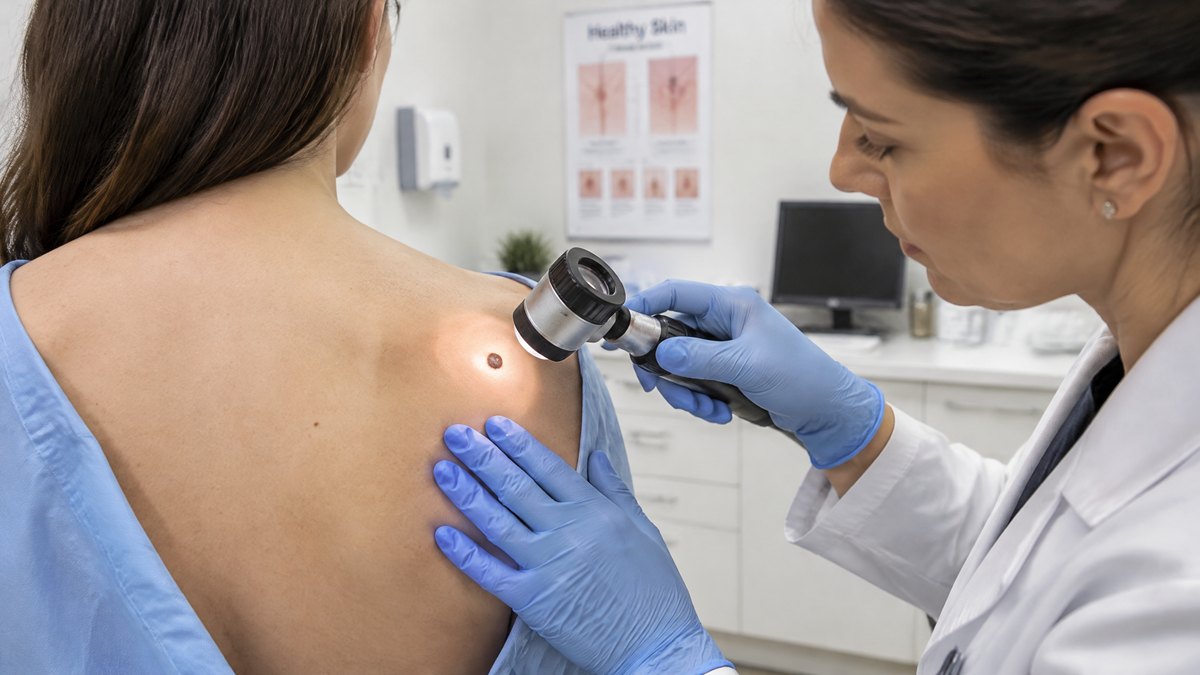
A GP or dermatologist will begin with a visual assessment, usually with a device called a dermatoscope — a specialised magnifier with a light that lets the clinician see structures within the mole invisible to the naked eye. This is painless and takes only a minute or two. In many cases, this is all that is needed, and you will be reassured and sent home.

If the appearance is ambiguous, the doctor may recommend a biopsy: a small sample of tissue sent to a laboratory for examination under a microscope. This is the only way to know definitively whether a mole is benign or malignant, and it is a minor procedure performed under local anaesthetic. You will feel a small sting from the injection and then nothing. Results typically return within one to two weeks.
In some clinics, especially in Australia and parts of Europe, artificial intelligence tools now assist dermatologists by analysing dermatoscopic images and flagging lesions that merit closer review. These are aids, not replacements — the clinical judgement of a trained human remains central — but they have improved detection rates in several studies.
What Removal Actually Involves
When a mole is suspicious, the standard approach is a diagnostic excision: the entire mole is removed, not just sampled, and sent for analysis. This is done under local anaesthetic in a clinic room, usually takes fifteen to thirty minutes, and leaves a small wound closed with a few stitches. The stitches come out after one to two weeks, depending on the site and your healing.
If the biopsy confirms melanoma, the next step depends on how deep the cancer has grown — measured in fractions of a millimetre, which is why early detection matters so much. A very thin melanoma may need no further treatment beyond the initial excision with a margin of healthy skin. A thicker one may require a wider excision and a procedure called a sentinel lymph node biopsy to check whether cancer cells have reached the nearby lymph nodes. More advanced cases may involve immunotherapy or targeted drug therapy, which have transformed outcomes for melanoma patients over the past decade.
For moles removed purely for cosmetic or comfort reasons, the procedure is simpler and the pathology check is still worthwhile. There is no benefit to leaving a mole that bothers you in place if removing it is straightforward.
Reducing Your Risk Going Forward
Prevention does not mean avoiding the sun entirely — that is neither realistic nor desirable. It means being sensible about it. Seek shade during the middle of the day when ultraviolet radiation is strongest, wear a broad-spectrum sunscreen of at least SPF 30 and reapply every two hours, cover up with a hat and long sleeves, and never use a tanning bed. Tanning is not a sign of health; it is visible evidence of DNA damage in your skin cells.
Be particularly careful with children. Sunburn in childhood significantly increases lifetime melanoma risk, and young skin is more vulnerable. Teaching a child to wear a hat and sunscreen is a health habit with decades of payoff.
When to Book, and When to Panic
Here is the reassuring part: the vast majority of moles that get checked turn out to be completely harmless. The purpose of checking is not to find cancer everywhere — it is to find the rare one early, when treatment is simple and outcomes are excellent. Five-year survival for melanoma detected at the earliest stage exceeds 95 per cent. At the late stage, the numbers fall dramatically. That gap is the entire argument for acting on a nagging feeling rather than talking yourself out of it.
Book an appointment if any of the five signs above apply to you. Do not wait for pain — melanoma usually does not hurt. Do not wait for bleeding — by then it may already have been growing for some time. And if you are unsure whether something is worth mentioning, mention it anyway. A doctor would far rather examine a harmless mole than treat an advanced melanoma that could have been caught two years earlier.
This article is for general information and is not a substitute for professional medical advice. If you have a mole or skin lesion that concerns you, speak to a GP or dermatologist — a qualified clinician can examine it properly and advise on whether removal or further tests are needed.

Leave a comment
This site is protected by hCaptcha and the hCaptcha Privacy Policy and Terms of Service apply.