
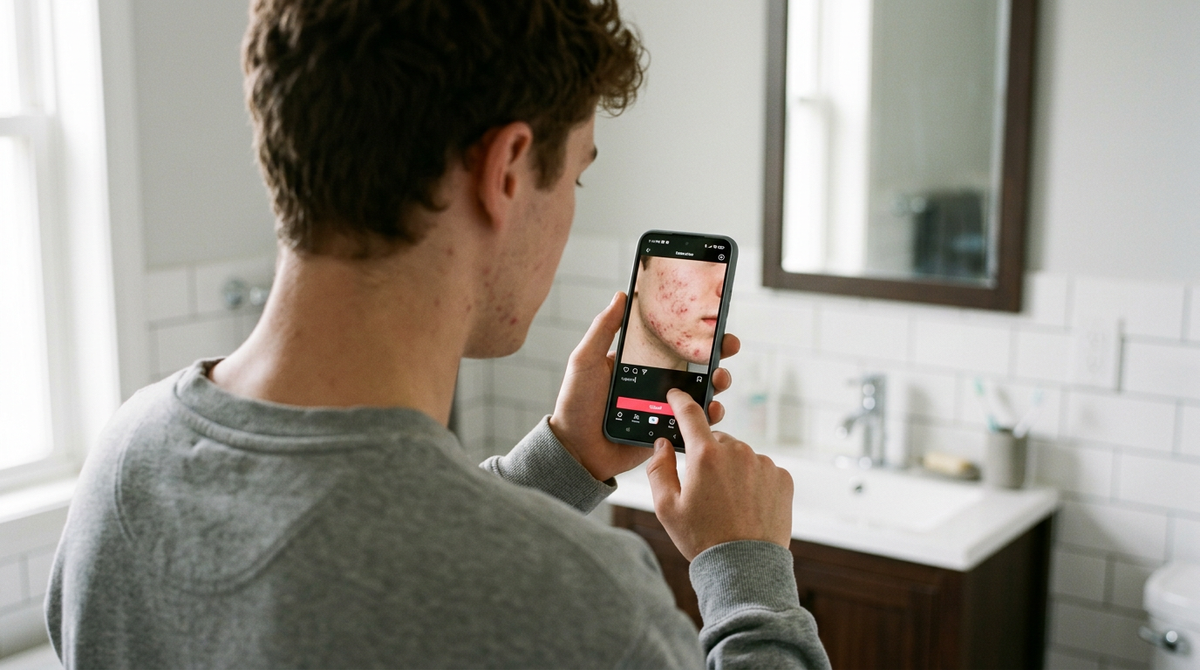
Why We Start with Photos: The First Step to Your Custom Treatment Plan
Every person’s skin has a story. Redness, breakouts, pigmentation, fine lines and changes in texture can all reveal something about its condition - but creating an effective treatment plan requires more than simply naming a concern. We need to understand how it appears across the face, how severe it may be and how different areas of the skin are affected.
That is why your skincare consultation starts with photos.
Clear, well-taken images provide valuable visual information before recommendations are made. They help us assess your skin more carefully, understand your priorities and create a plan tailored to you rather than relying on a generic routine.
Photos help us see the complete picture
When describing your skin, you might say that it feels dry, looks congested or has recently become more sensitive. That information is important, but photographs add another layer of detail.
Photos may help us observe:
- The location and distribution of breakouts
- Patterns of redness or irritation
- Uneven tone and areas of pigmentation
- Fine lines and visible signs of ageing
- Dryness, flaking or a compromised skin barrier
- Enlarged pores, congestion and changes in texture
- Differences between one area of the face and another
For example, occasional blemishes around the chin may require a different approach from widespread congestion across the cheeks and forehead. Similarly, isolated pigmentation may not be treated in the same way as general dullness or uneven tone.
Seeing these distinctions allows us to make more informed recommendations from the beginning.
Your skin is unique
Two people may select the same main concern on a consultation form but have very different needs.
One person experiencing breakouts may also have oily, resilient skin. Another may have blemishes alongside dryness, sensitivity and a weakened skin barrier. Recommending the same active ingredients to both people could leave one with a routine that is unnecessarily harsh.
Your photos help us look beyond the label and consider the visible condition of your skin as a whole. Combined with information about your skin history, current routine, lifestyle and goals, they provide the foundation for a genuinely personalised plan.
This matters because good skincare is not about using the greatest possible number of products or choosing the highest concentration available. It is about selecting appropriate ingredients, introducing them at the right pace and ensuring that the routine remains manageable.
Better recommendations begin with better information
A customised plan must balance effectiveness with tolerance. Photos help us decide where to place that balance.

If your skin appears dry or visibly sensitised, the first priority may be hydration and barrier support rather than immediately introducing several powerful active ingredients. A product such as REFORM Skincare Vitamin B5 Gel or Skin Barrier Repair Cream may be considered when additional hydration or barrier support is appropriate.

If uneven tone or signs of environmental damage are the main concerns, antioxidant protection and daily sunscreen may form part of the plan. Depending on your skin’s needs and tolerance, this could include REFORM Skincare Vitamin C 20% Serum alongside SPF 50+ Antioxidant Sunscreen.
For blemish-prone skin, a targeted option such as Anti-Blemish Crème may be relevant. However, no product should be recommended simply because a concern fits into a broad category. The overall condition of the skin must still be considered.
Photos do not determine the entire routine on their own, but they help ensure that each recommendation has a clear purpose. REFORM Skincare describes its range as doctor-formulated cosmeceutical skincare and offers products and routines for concerns including blemishes, ageing, rosacea and barrier damage. REFORM Skincare
Photos establish a useful starting point
Skin changes gradually, which can make progress difficult to recognise from day to day. Your initial photographs create a visual baseline against which future images can be compared.
Over time, comparison photos may help show:
- Whether redness appears calmer
- Whether breakouts are becoming less frequent
- Whether pigmentation looks more even
- Whether texture appears smoother
- Whether dryness and flaking have improved
- Whether the routine needs to be adjusted
Progress is not always perfectly linear. Skin may fluctuate because of stress, hormones, weather, travel, illness or changes in routine. A series of consistent photographs can make broader trends easier to identify, even when there are occasional setbacks.
They also help prevent unnecessary changes. If the skin is improving gradually, replacing several products too soon could interrupt that progress. If little has changed after a reasonable period, the plan can be reviewed with better evidence.
How to take useful consultation photos
The most helpful photos are clear, natural and consistent. You do not need professional equipment; a modern smartphone is usually sufficient.
For the best results:
- Use natural daylight. Stand near a window, but avoid harsh direct sunlight that creates strong shadows.
- Remove make-up. Foundation, concealer, tinted skincare and heavy powders can hide redness, pigmentation and texture.
- Clean the camera lens. A quick wipe can significantly improve image clarity.
- Avoid filters and editing. Beauty modes, colour correction and smoothing features can alter the appearance of your skin.
- Keep your hair away from your face. Make sure the forehead, temples, cheeks and jawline are visible.
- Take several angles. Include one photograph from the front and one from each side. A closer image may be useful for a specific concern.
- Keep a neutral expression. This makes it easier to assess the skin without temporary lines caused by smiling or frowning.
- Use the rear camera when possible. It often produces a clearer image than the front-facing camera.
For future progress photographs, try to use the same room, lighting, distance and angles. Consistency makes comparisons more reliable.
What photos cannot tell us
Photographs are a valuable assessment tool, but they are only one part of the process. They cannot show how your skin feels, explain when a concern started or reveal which products may have triggered a reaction.
That is why your consultation details matter just as much. Information about allergies, sensitivities, medications, pregnancy or breastfeeding, previous treatments and current products can affect what is appropriate for you.

Photos are also not a substitute for a medical diagnosis. Any mole, persistent rash, rapidly changing lesion, painful swelling or other worrying symptom should be assessed by a qualified healthcare professional.
A personal plan starts with understanding
Sending photos may feel like a small step, but it plays an important role in building a thoughtful skincare plan. It allows us to assess your concerns in context, choose products more carefully and create a baseline for monitoring progress.
The aim is not to judge your skin or search for imperfections. It is to understand what your skin needs now and develop a routine that supports your goals without overwhelming it.
Your photos begin the conversation. From there, we can create a custom treatment plan with clear priorities, appropriate products and realistic expectations - because effective skincare begins with seeing the whole picture.


Leave a comment
This site is protected by hCaptcha and the hCaptcha Privacy Policy and Terms of Service apply.