
Why SPF 50+ Matters: The Clinical Importance of High-Factor Sunscreen
In the realm of preventative dermatology, few tools are as scientifically scrutinized or as clinically essential as sunscreen. While the skincare industry is flooded with high-performance actives like retinoids and vitamin C, the cornerstone of any medical-grade regimen remains photoprotection. Specifically, the transition from moderate protection to SPF 50+ represents a significant threshold in safeguarding cutaneous health.
Understanding why this specific rating matters requires moving beyond marketing terminology and into the physiological impact of Ultraviolet (UV) radiation on human tissue.
The Physics of SPF: More Than Just a Number
The Sun Protection Factor (SPF) is a relative measure of how long a sunscreen will protect skin from ultraviolet B (UVB) rays, the primary cause of erythema (sunburn) and direct DNA damage.
To visualize the efficacy gap between ratings, it is helpful to look at the percentage of UVB rays filtered:
-
SPF 15 filters approximately 93% of UVB rays.
-
SPF 30 filters approximately 97% of UVB rays.
-
SPF 50+ filters approximately 98% to 99% of UVB rays.
While the jump from 97% to 98% may appear marginal on paper, the clinical reality is different. For patients with photosensitive conditions, a history of skin malignancies, or those undergoing active clinical treatments (such as chemical peels or laser resurfacing), that extra 1% to 2% of filtration represents a significant reduction in cumulative solar load. Furthermore, because most individuals apply only a fraction of the amount of sunscreen used in laboratory testing, starting with a higher baseline of SPF 50+ provides a necessary safety net against "under-application."
The Biological Necessity of SPF 50+
The skin is the body's largest organ and its primary interface with the environment. When UV radiation penetrates the epidermis, it triggers a cascade of biological events that extend far beyond a temporary tan or burn.
1. Prevention of Photocarcinogenesis
UVB radiation is a known mutagen. It causes the formation of cyclobutane pyrimidine dimers (CPDs) in the DNA of keratinocytes. If the body’s nucleotide excision repair process cannot keep up with the rate of damage, mutations can occur, leading to basal cell carcinoma, squamous cell carcinoma, or melanoma. Utilizing an SPF 50+ formulation ensures the highest level of defense against these cumulative genetic insults.
2. Management of Post-Inflammatory Hyperpigmentation (PIH)
For patients dealing with acne scarring or melasma, UV exposure is the primary antagonist. Even minimal sun exposure can darken existing pigment and prolong the healing process. Clinical-grade protection at the 50+ level is vital for "freezing" pigment production, allowing therapeutic brightening agents to work effectively without constant environmental interference.
3. Preservation of the Dermal Matrix (Anti-Aging)
While UVB causes burns, UVA rays (which SPF 50+ broad-spectrum formulas also defend against) penetrate deeper into the dermis. This leads to the degradation of collagen and elastin fibers—a process known as solar elastosis. The result is premature wrinkling, loss of elasticity, and "leathery" skin texture. High-factor protection is, quite literally, the most effective anti-aging treatment available in a clinical setting.
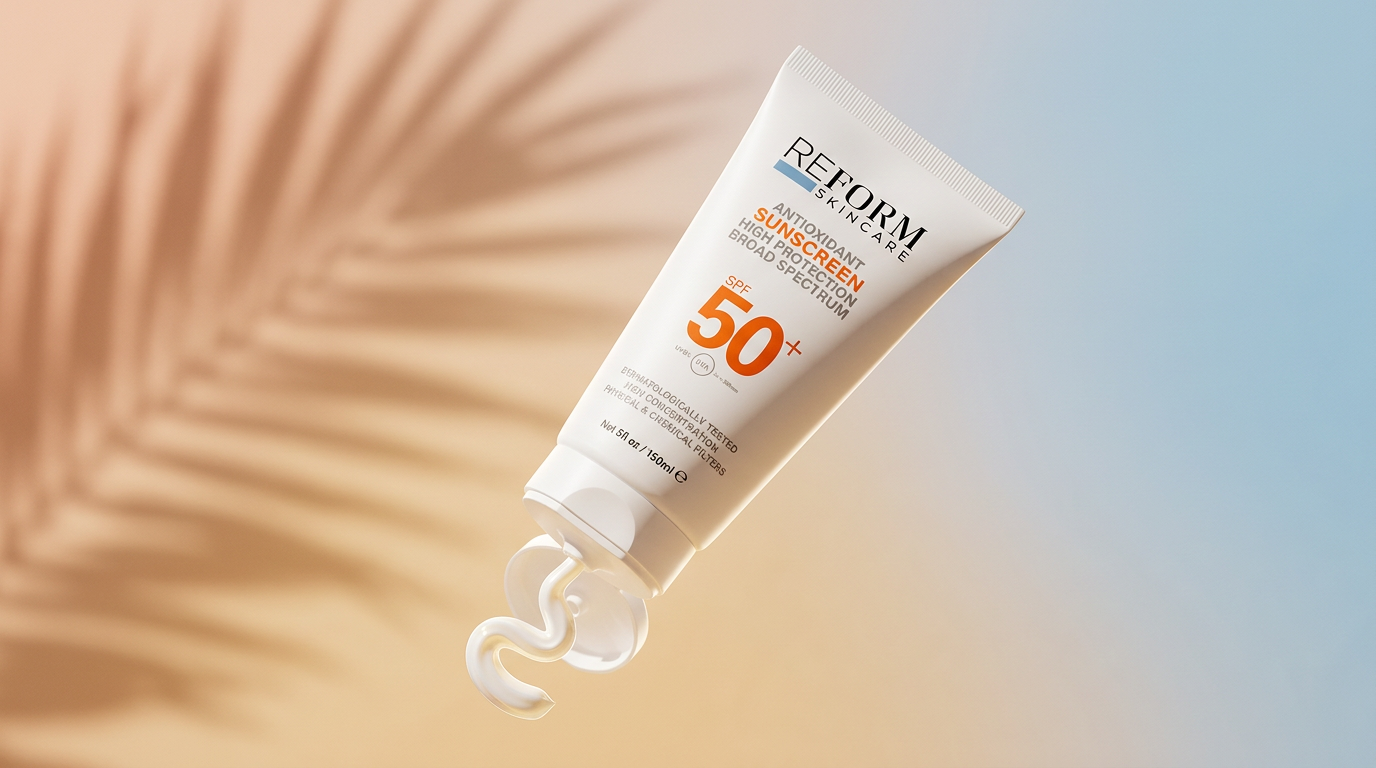
In a clinical environment, the efficacy of a sunscreen is determined not just by its rating, but by its formulation stability and patient compliance. REFORM Skincare Antioxidant Sunscreen SPF 50+ is frequently integrated into post-procedure protocols and daily maintenance routines due to its advanced filtration system.

This formulation is designed to provide high-level, broad-spectrum protection while maintaining a texture that encourages daily use. In dermatology, the "best" sunscreen is the one a patient is willing to wear every day. REFORM Skincare addresses the common complaints of heaviness or "white cast" often associated with high-SPF products, providing a finish that sits comfortably under makeup or as a standalone final step in a medical-grade skincare routine.
By incorporating both chemical and/or physical filters, this product ensures that energy from the sun is either absorbed and released as heat or reflected away from the skin’s surface, providing a dual-action shield against environmental stressors.
The "Application Gap": Why High SPF is a Safety Net
One of the most compelling arguments for SPF 50+ in a clinical setting is the "Application Gap." Laboratory testing requires an application of 2mg/cm² of skin. In practice, most patients apply between 0.5 and 1.0mg/cm².
When a lower SPF (such as 15 or 30) is applied too thinly, the actual protection achieved can drop exponentially. By utilizing an SPF 50+ formulation, patients are more likely to achieve a functional level of protection that mimics an SPF 30, even if their application technique is imperfect. It provides a margin for error that is essential for maintaining skin integrity in high-UV environments.
Addressing Common Misconceptions
"I work indoors, so I don't need SPF 50+." Medical observation confirms that UVA rays can penetrate standard window glass. Furthermore, "blue light" (HEV light) from digital screens can contribute to oxidative stress. A high-factor sunscreen like REFORM Skincare SPF 50+ provides a comprehensive barrier against these indirect exposures.
"I have dark skin, so a high SPF is unnecessary." While higher melanin levels provide a natural baseline protection (roughly equivalent to SPF 13), this is insufficient to prevent DNA damage, hyperpigmentation, and skin cancer. Patients of all phototypes benefit from the inflammatory-reducing properties of SPF 50+.
Conclusion: A Commitment to Long-Term Health
Choosing an SPF 50+ is more than a cosmetic preference; it is a clinical decision to prioritize the longevity and health of the cutaneous system. By utilizing advanced formulations like REFORM Skincare Antioxidant Sunscreen SPF 50+, patients can ensure they are receiving the maximum allowable protection against the spectrum of solar damage.
In the journey toward healthy, resilient skin, the daily application of high-factor sun protection remains the single most important intervention a patient can perform. It is the bridge between clinical treatments and long-term, sustainable results.


Leave a comment
This site is protected by hCaptcha and the hCaptcha Privacy Policy and Terms of Service apply.