
Why Professional Skin Cancer Screening Saves Lives
Skin cancer is the most common cancer in the world, and it's growing more prevalent every year. In the United States alone, 1 in 5 Americans will develop skin cancer by the age of 70. Melanoma incidence has surged by a staggering 320% since 1975, making early detection more critical than ever before. Yet here's the remarkable truth that should give everyone hope: when caught early through professional screening, the 5-year survival rate for melanoma exceeds 99%. This single statistic encapsulates why professional skin cancer screening isn't just a medical recommendation—it's a life-saving intervention.
The Stark Reality of Skin Cancer Today

In 2025, an estimated 104,960 new cases of invasive melanoma and 107,240 cases of in situ melanoma will be diagnosed in the United States. While melanoma accounts for only about 1% of all skin cancer cases, it's responsible for the majority of skin cancer deaths, claiming approximately 8,430 lives annually.
Beyond melanoma, basal cell carcinoma and squamous cell carcinoma (collectively known as keratinocyte carcinomas) affect millions more. A recent study estimated that 5.4 million cases of these non-melanoma skin cancers were diagnosed among 3.3 million people in a single year—many of whom experienced multiple occurrences.
These numbers aren't just statistics. They represent parents, children, friends, and colleagues whose lives hang in the balance between early detection and late diagnosis. The difference between these two outcomes often comes down to one thing: professional skin cancer screening.
The Detection Gap: Why Self-Examination Isn't Enough
Many people believe that regularly checking their own skin is sufficient protection against skin cancer. While self-examinations play an important supporting role, research reveals significant limitations that make professional screening irreplaceable.
Studies show that fewer than 8% of individuals performing self-skin examinations check every body part detailed in medical protocols. The average person conducting a self-exam checks only about two-thirds of their body, leaving critical areas unexamined. Worse still, research indicates that self-detected melanomas are more likely to be thicker, higher-risk cancers with poorer prognoses. This suggests that by the time most people notice something suspicious on their own, the cancer has already progressed to a more dangerous state. National Institutes of Health
The challenge lies in the nature of skin cancer itself. Only 20 to 30 percent of melanomas develop from existing moles—70 to 80 percent arise on apparently normal skin. Without trained eyes and specialized tools, distinguishing between a harmless spot and a potentially deadly melanoma is exceptionally difficult. The subtle differences in color variation, border irregularity, and asymmetry that dermatologists are trained to recognize can easily escape an untrained observer.
The Professional Advantage: Training, Tools, and Expertise
Dermatologists undergo years of specialized training specifically focused on skin conditions and diseases. This expertise translates directly into better patient outcomes. Research demonstrates that direct access to dermatological screenings correlates with earlier detection of melanoma and improved long-term survival.
A landmark study on German patients diagnosed with melanoma found that those who had participated in a dermatological screening program had significantly higher survival rates than those who did not. This isn't coincidental—it reflects the fundamental advantage of having a trained specialist examine your skin.
Professional screenings offer several distinct benefits that self-examination simply cannot match:
Comprehensive full-body examination. Dermatologists systematically examine every inch of skin, including areas patients cannot easily see themselves—the scalp, back, buttocks, and the soles of the feet. These hard-to-see areas are particularly concerning for certain populations; melanomas in Black, Asian, and native Hawaiian patients most often occur on non-exposed skin such as the palms, soles, and nail regions.
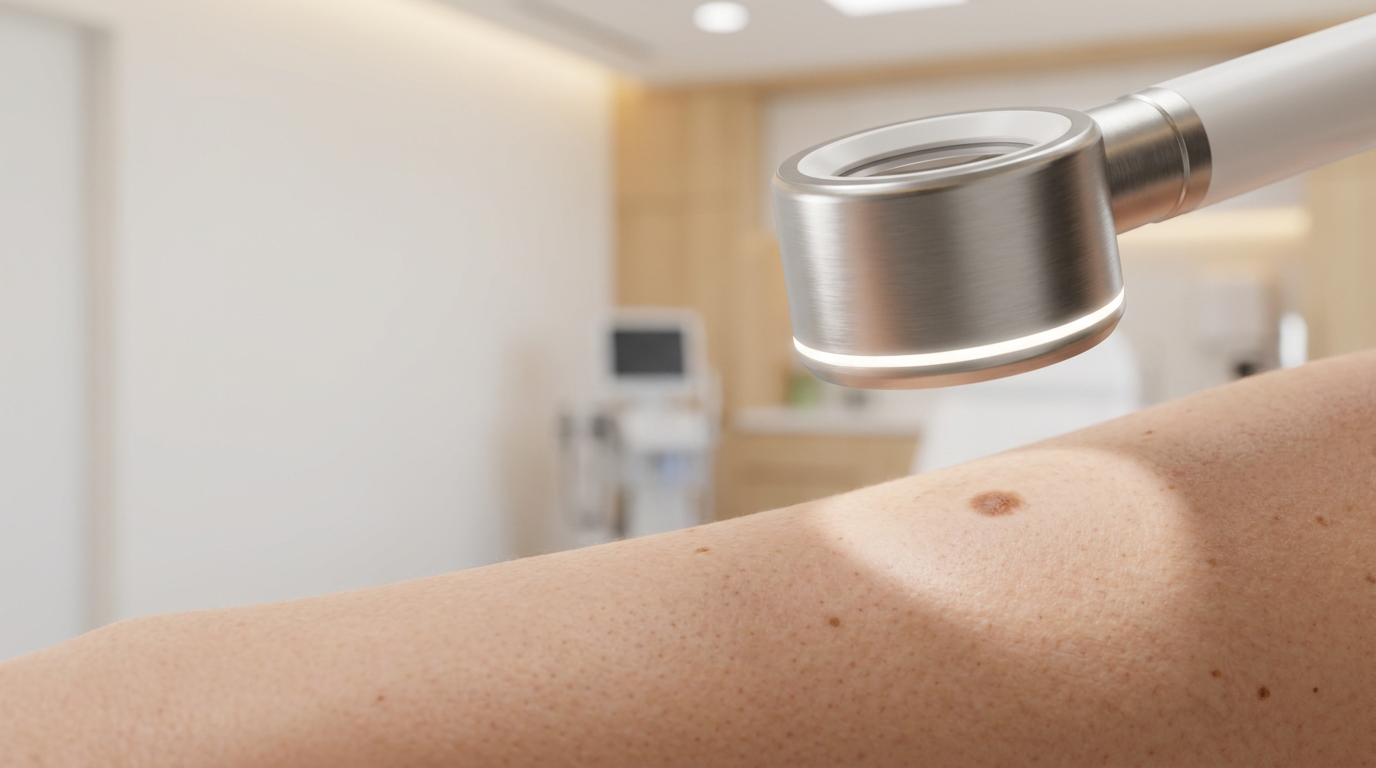
Dermoscopy and advanced imaging. Professional screenings often employ dermoscopes—specialized magnifying instruments that allow dermatologists to see structures beneath the skin's surface invisible to the naked eye. Many practices now incorporate digital imaging and artificial intelligence-assisted tools that can track changes in lesions over time with millimeter precision.
Pattern recognition expertise. Dermatologists see thousands of skin lesions throughout their careers. This experience creates a level of pattern recognition that even the most diligent self-examiner cannot develop. They can differentiate between the countless benign spots that dot human skin and the rare but dangerous anomalies that require immediate attention.
Immediate biopsy capability. When a dermatologist identifies a suspicious lesion, they can often perform a biopsy during the same appointment. This eliminates delays that can prove fatal—and the data on delays is sobering.
Time Is Tissue: The Critical Importance of Speed
One of the most compelling arguments for professional screening lies in the relationship between detection timing and survival outcomes. The numbers paint an unmistakable picture:
- Localized melanoma (detected early): 5-year survival rate exceeds 99%
- Regional spread (lymph node involvement): 5-year survival rate drops to 76%
- Distant metastasis (spread to other organs): 5-year survival rate falls to 35%
These figures reveal the brutal arithmetic of delayed detection. A melanoma caught early is almost always curable. The same melanoma caught late kills roughly two-thirds of patients within five years.
Treatment timing matters enormously as well. Research shows that compared with stage I melanoma patients treated within 30 days of biopsy, those treated 30 to 59 days after biopsy have a 5% higher risk of dying from the disease. Most alarmingly, those treated more than 119 days after biopsy face a 41% higher risk of death. Every week of delay increases danger.
Professional screening accelerates the entire detection-to-treatment pipeline. A dermatologist who spots a suspicious lesion can biopsy it immediately, often receiving pathology results within days. Treatment can begin within weeks of initial detection. This compressed timeline saves lives.
Addressing Disparities in Screening Access and Outcomes
The benefits of professional screening are not equally distributed across all populations. Significant disparities exist in both access to dermatological care and skin cancer outcomes among different demographic groups.
The estimated 5-year melanoma survival rate for Black patients is 70%, compared with 95% for white patients. This gap reflects multiple factors, including later-stage diagnoses. The statistics are troubling: 52% of non-Hispanic Black patients and 26% of Hispanic patients receive an initial diagnosis of advanced-stage melanoma, versus only 16% of non-Hispanic white patients.
These disparities make professional screening even more critical for underserved communities. Because melanomas in people with darker skin tones often appear in atypical locations—the palms, soles, and under nails—they're easily missed by individuals unfamiliar with these presentation patterns. Dermatologists trained in recognizing skin cancer across all skin types can catch these cancers before they spread.
Expanding access to professional skin cancer screening represents both a medical imperative and a matter of health equity. Community screening programs, teledermatology services, and training primary care providers in skin cancer detection are all strategies that can help close this gap.
When and How Often Should You Get Screened?
The Skin Cancer Foundation recommends annual full-body skin examinations by a dermatologist for all adults. However, certain risk factors warrant more frequent screening:
- Personal history of skin cancer: If you've had skin cancer before, your risk of recurrence is elevated
- Family history of melanoma: Genetic factors play a significant role in melanoma risk
- High mole count: Having many moles, or atypical moles, increases risk
- Fair skin, light hair, and light eyes: These traits indicate less natural protection from UV radiation
- History of severe sunburns: Having five or more sunburns doubles your melanoma risk
- History of indoor tanning: Tanning bed use significantly increases skin cancer risk
- Weakened immune system: Immunosuppression elevates skin cancer risk
For those at higher risk, dermatologists may recommend screenings every three to six months rather than annually.
Making Professional Screening Work for You
To maximize the benefits of professional skin cancer screening, take an active role in your own care:
Document changes. Before your appointment, note any new spots or changes in existing moles. Take photographs if possible—this gives your dermatologist valuable comparative information.
Communicate your history. Share your family history of skin cancer, your sun exposure habits, and any previous skin cancer diagnoses or treatments.
Ask questions. Don't hesitate to ask about any spots that concern you, even if they seem minor. Your observations can guide the examination.
Follow through. If your dermatologist recommends a biopsy or follow-up appointment, schedule it promptly. Remember the data on treatment delays—time matters.
Maintain regular self-checks between appointments. Professional screening is most effective when combined with monthly self-examinations. Think of self-checks as an early warning system between professional visits.
A Simple Act That Saves Lives
Skin cancer is unique among cancers in one crucial respect: it's visible. Unlike cancers that develop silently inside the body, skin cancer grows on our outer surface where it can be seen, examined, and caught early. This visibility is a gift—but only if we use it wisely.
Professional skin cancer screening transforms that visibility into saved lives. A dermatologist's trained eyes, specialized tools, and systematic approach catch cancers that self-examination misses. Early detection shifts survival odds from coin-flip uncertainty to near certainty.
The math is simple and irrefutable. A professional skin exam takes about fifteen minutes. Those fifteen minutes can detect a cancer early enough to achieve a 99% survival rate—or prevent the tragedy of a late-stage diagnosis with a 35% survival rate. Few medical interventions offer such dramatic returns on such a minimal investment.
Skin cancer rates continue to climb. But mortality rates are finally declining, thanks largely to earlier detection and improved treatments. Professional screening stands at the center of this progress, serving as the critical intervention that catches cancer while it's still curable.
Schedule your screening. Encourage your loved ones to do the same. In the fight against skin cancer, professional screening isn't just good medicine—it's the difference between life and death.



Leave a comment
This site is protected by hCaptcha and the hCaptcha Privacy Policy and Terms of Service apply.