
Sun Safety 101: Expert Tips for a Cancer-Free Summer
As the temperature rises and the days grow longer, the allure of the great outdoors becomes irresistible. Whether it’s a weekend at the beach, a hike through the mountains, or a simple afternoon in the garden, summer is a season defined by the sun. However, with that golden glow comes a significant responsibility: protecting your skin from the invisible dangers of ultraviolet (UV) radiation.
At the clinic, we believe that education is the first line of defense against skin cancer. Every year, millions of people are diagnosed with skin cancer, yet it remains one of the most preventable forms of the disease. By understanding how the sun affects your biology and adopting a proactive protection strategy, you can enjoy the warmth of summer while keeping your skin healthy, youthful, and cancer-free.
The Science of the Sun: Understanding UV Radiation
To protect your skin, you must first understand the "enemy." The sun emits different types of radiation, but when it comes to skin health, two types are of primary concern: UVA and UVB.
UVA: The "Aging" Rays
UVA rays have a longer wavelength, allowing them to penetrate deep into the thickest layer of the skin (the dermis). These rays are present with relatively equal intensity during all daylight hours throughout the year, even on cloudy days. UVA radiation is responsible for long-term skin damage, such as wrinkles, loss of elasticity, and "sun spots." More importantly, UVA contributes significantly to the development of skin cancers.
UVB: The "Burning" Rays
UVB rays have a shorter wavelength and primarily reach the outer layer of the skin (the epidermis). These are the rays responsible for the immediate redness of a sunburn. UVB intensity varies by season, location, and time of day, peaking between 10:00 AM and 4:00 PM. While UVB is essential for Vitamin D synthesis, overexposure leads to DNA damage that can trigger the uncontrolled growth of skin cells.
The Adare Clinic Guide to Sun Protection
Sun safety is not a singular action; it is a multi-layered approach. Relying solely on one method—like a quick spray of sunscreen in the morning—often leads to "missed spots" and a false sense of security. Here is the expert-recommended protocol for total protection.
1. Timing is Everything
The most effective way to avoid sun damage is to avoid the sun when it is at its most potent. The UV Index is a standard measurement of the strength of sunburn-producing UV radiation at a particular place and time.
-
The Shadow Rule: A simple trick to gauge UV intensity is the shadow test. If your shadow is shorter than you are, the sun’s rays are at their strongest, and you should seek shade immediately.
-
Peak Hours: Aim to plan outdoor activities for the early morning or late evening. If you must be outside during midday, seek the "deep shade" of trees or buildings.
2. Physical Barriers: Clothing as Armor
Before you reach for a bottle, reach for your wardrobe. Clothing provides a physical block that doesn't wear off or require reapplication.
-
UPF Clothing: Look for garments with an Ultraviolet Protection Factor (UPF) rating. A UPF of 50 allows only 1/50th of the sun's UV radiation to reach the skin.
-
Dense Weaves: If you aren't wearing specialized gear, choose tightly woven fabrics like denim or synthetic fibers over loose knits like lace or linen.
-
Broad-Brimmed Hats: A hat should protect more than just the top of your head. Ensure it has at least a 3-inch brim to shield the ears, back of the neck, and the nose—common sites for basal cell carcinoma.
3. The Truth About SPF
Sun Protection Factor (SPF) is a measure of how much solar energy (UV radiation) is required to produce sunburn on protected skin relative to the amount of solar energy required to produce sunburn on unprotected skin.
Many people believe that SPF 30 is twice as strong as SPF 15. In reality:
-
SPF 15 blocks about 93% of UVB rays.
-
SPF 30 blocks about 97% of UVB rays.
-
SPF 50 blocks about 98% of UVB rays.
The key isn't necessarily finding the highest number possible, but rather finding a "Broad Spectrum" formula that protects against both UVA and UVB and applying it correctly.
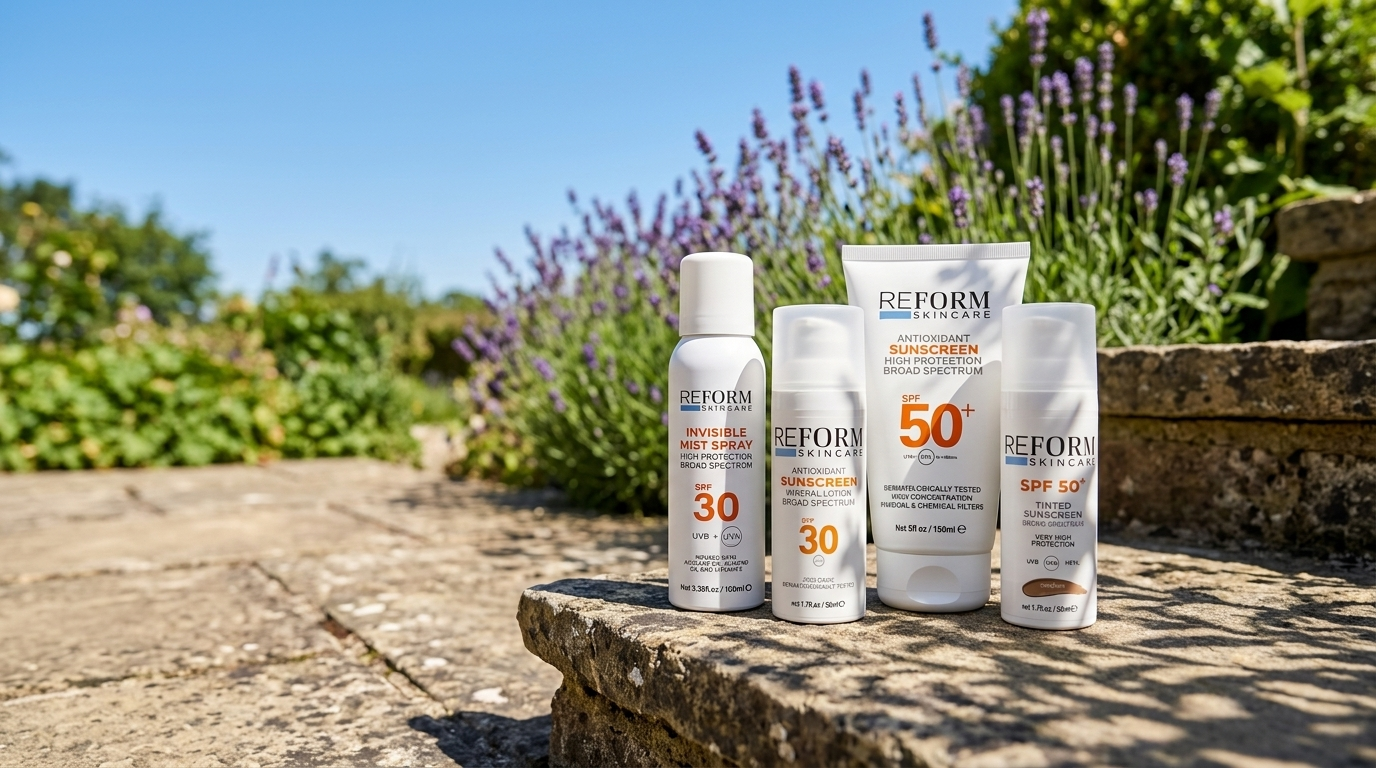
Professional Grade Protection: REFORM Skincare
While lifestyle changes are vital, the quality of the products you apply to your skin makes a profound difference in both safety and skin health. This is where the REFORM Skincare range excels. Formulated with dermatological precision, these products are designed to provide maximum protection without the heavy, greasy feel of traditional sunscreens.
REFORM Skincare SPF 30
For daily use, the SPF 30 formula is a cornerstone of any skincare routine. It is specifically designed for those who need reliable protection during a standard day.

-
The Texture: It is lightweight and non-comedogenic (won't clog pores), making it ideal for layering under makeup or over your morning moisturizer.
-
The Benefit: It provides a balanced shield against daily UV exposure, helping to prevent the "cumulative" damage that leads to premature aging.
REFORM Skincare SPF 50
When you know you will be spending extended periods outdoors—whether at the beach, on a boat, or playing sports—the SPF 50 is the gold standard.

-
Maximum Defense: This high-potency formula is designed for environments where UV reflection (from sand, water, or snow) increases the risk of burning.
-
Antioxidant Support: Often, REFORM formulations include skin-conditioning agents that help soothe the skin while the physical and chemical filters do the heavy lifting.
The "Golden Rules" of Application
Even the best REFORM Skincare product will fail if it isn't used correctly. Follow these professional tips to ensure your coverage is "gap-free":
-
The Two-Finger Rule: To get the advertised SPF on your face and neck, you need more than a "pea-sized" amount. Squeeze two strips of sunscreen along the length of your index and middle fingers. This is the amount required for full coverage of the face and neck.
-
The 20-Minute Head Start: Chemical sunscreens need time to absorb into the skin to be effective. Apply your REFORM SPF at least 20 minutes before stepping out the door.
-
The Reapplication Mantra: Sunscreen breaks down under UV light and is easily rubbed off by sweat or towels. You must reapply every two hours, or immediately after swimming or heavy perspiring.
-
Don’t Forget the "Hidden" Spots: Skin cancer frequently appears on the tops of the feet, the ears, the scalp (along the part line), and the lips. Use a dedicated lip balm with SPF and be meticulous with your application.
Beyond the Burn: Monitoring Your Skin
Sun safety doesn't end when you go back inside. The Adare Clinic recommends a monthly "Skin Self-Exam." This practice helps you become familiar with your skin's patterns so you can spot changes early.
Use the ABCDE method for checking moles:
-
A - Asymmetry: One half of the mole does not match the other.
-
B - Border: The edges are ragged, blurred, or irregular.
-
C - Color: The color is not uniform; it may have shades of tan, brown, black, blue, or red.
-
D - Diameter: The spot is larger than 6mm (about the size of a pencil eraser).
-
E - Evolving: The mole is changing in size, shape, or color.
If you notice any of these signs, or a "sore that won't heal," it is imperative to book a professional screening at the clinic immediately. Early detection of skin cancer has a nearly 99% 5-year survival rate.
Conclusion: A Lifestyle of Protection
A "Cancer-Free Summer" isn't about hiding in the dark; it’s about being smart in the light. By combining the expert advice from Adare Clinic—seeking shade, wearing protective clothing, and monitoring your skin—with the advanced technology of REFORM Skincare SPF 30 and SPF 50, you are doing more than just preventing a burn. You are investing in the long-term health and vitality of your body's largest organ.
This summer, make sun safety as habitual as brushing your teeth. Your skin will thank you for years to come.

Leave a comment
This site is protected by hCaptcha and the hCaptcha Privacy Policy and Terms of Service apply.