
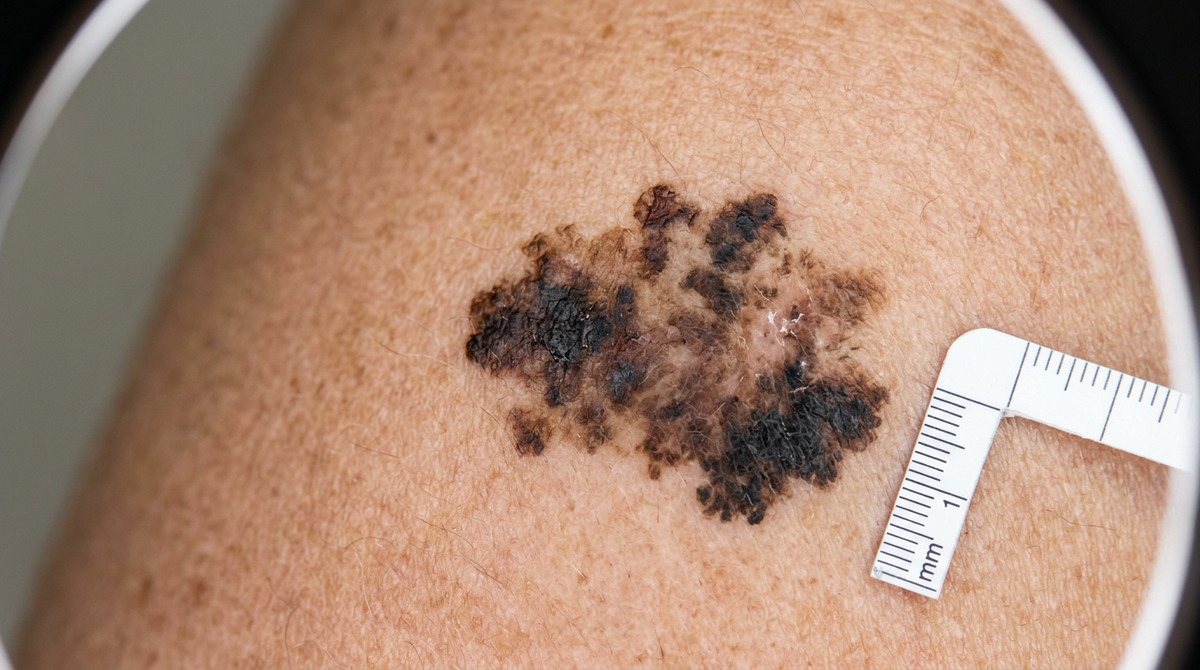
Spotting Melanoma on Your Legs: Early Warning Signs and What to Look For
Melanoma is a type of skin cancer that develops in melanocytes, the cells responsible for producing pigment. Although it is less common than some other skin cancers, it can spread to other parts of the body if it is not detected and treated early.
It can develop anywhere, including areas that receive little sun exposure. The legs deserve particular attention: they are the most common site for melanoma in women, although anyone can develop melanoma there.
Regularly checking your legs can help you notice a suspicious mark early. You do not need specialist equipment, but you do need to know what is normal for your skin and recognise when something changes.
What can melanoma on the leg look like?
Melanoma may begin as a new mark or mole, but it can also develop in an existing mole. Many harmless moles are evenly shaped, have smooth borders and remain much the same over time. A melanoma may look noticeably different or begin changing over weeks or months.
It is often brown or black, but colour alone cannot identify it. Melanoma can also appear pink, red, blue, white or skin-coloured. It may be flat or raised, and some melanomas contain several colours.
The ABCDE guide is a useful way to assess a mole or pigmented mark.
A - Asymmetry
Imagine drawing a line through the centre of the mark. If one half does not resemble the other, it may be asymmetrical. Many harmless moles are round or oval and broadly symmetrical, whereas melanoma can develop an uneven shape.
B - Border
Look closely at the edges. A suspicious lesion may have a border that is irregular, blurred, jagged, scalloped or poorly defined rather than smooth and clear.
C - Colour
Check for uneven colour or several shades within one mark. These may include brown, black, tan, red, pink, white or blue. A change in colour is also important, even if the mark remains a single shade.
D - Diameter
A diameter greater than about 6 mm - roughly the width of the end of a pencil - can be a warning sign. However, melanomas can be smaller, so do not dismiss a changing or unusual mark simply because it is tiny.
E - Evolving
Change is one of the most important clues. Watch for a mark that is growing or changing in its shape, colour, height or texture. New symptoms such as itching, soreness, bleeding, crusting or inflammation also warrant medical attention.
The ABCDE guide is helpful, but it is not a diagnostic test. A melanoma may not display every feature, and some do not fit the pattern at all.
Look for the "ugly duckling"
Most of a person's moles tend to share a general appearance. A mark that looks conspicuously different from the others may be an "ugly duckling" and should be checked.

For example, pay attention to one very dark spot among lighter moles, a raised mark when all the others are flat, or a single irregular lesion among otherwise rounded ones. A mark can be concerning because it is different, even if it does not meet the usual ABCDE criteria. Do not overlook raised or fast-growing lumps
Some melanomas, particularly nodular melanomas, may appear as a new, firm or raised lump rather than a flat, irregular mole. These can grow relatively quickly and may bleed or ooze.
Seek medical advice if you notice a lump that is:
- Elevated above the surrounding skin.
- Firm when touched gently.
- Growing steadily over several weeks.
A persistent pink, red, brown, black or skin-coloured lump should not be ignored merely because it does not resemble a conventional mole.
How to examine your legs properly
Check in a well-lit room and take your time. Examine the entire leg, not only the shin or other easily visible areas.
- Start at the hips and thighs. Inspect the front, sides and inner thighs.
- Check your knees and shins. Look across the kneecaps and around the sides of each knee.
- Use a mirror for the backs of your legs. Examine the backs of the thighs, calves and knees.
- Inspect your ankles and feet. Include the heels, soles, tops of the feet and the skin between the toes.
- Check your toenails. A new or changing dark streak beneath a nail, particularly one that spreads into the surrounding skin, needs assessment. Remember that injuries and other conditions can also discolour nails.
- Compare both legs. Look for anything new, changing or noticeably different from your other marks.
Photographs can help you monitor a particular mole, provided they are taken in similar lighting and from the same distance. Include a ruler for scale. Photographs are useful records, but they do not replace a clinical examination.
Melanoma can occur in every skin tone. On brown or black skin, suspicious changes may be easier to miss, and melanoma may appear on the soles, toes or beneath the nails. Some lesions may also lack the classic ABCDE features.
When should you see a doctor?
Arrange an appointment with your GP or dermatologist if you notice:
- A new or changing mole.
- A mark with any ABCDE feature.
- A lesion that looks unlike your other moles.
- A spot or lump that continues growing.
- Bleeding, crusting, oozing or inflammation without a clear explanation.
- Persistent itching, tenderness or pain.
- A sore that does not heal.
- A new dark streak under a toenail that is not clearly related to an injury.
Do not wait for a suspicious mark to hurt. Early melanoma often causes no discomfort. A clinician can examine it properly and, when necessary, arrange specialist assessment. Only a qualified medical professional can diagnose melanoma.
Protecting your legs from UV exposure
Skin checks help with early recognition, but prevention matters too. Avoid sunbeds and reduce exposure when ultraviolet radiation is strongest. Clothing provides useful protection, while broad-spectrum sunscreen should be applied generously to uncovered areas such as the thighs, knees, calves, ankles and tops of the feet.

The REFORM Skincare SPF 50+ Antioxidant Sunscreen is one high-protection option for exposed skin. REFORM also offers SPF 30 and SPF 50 sunscreen formats. Whichever product you choose, follow its directions, reapply regularly and remember that sunscreen does not make prolonged sun exposure risk-free. Shade and protective clothing remain important.
Sunscreen cannot treat melanoma, reverse an existing suspicious change or replace professional assessment. Cosmetic products and automated skin-analysis tools should not be used to decide whether a mole is cancerous.
Make checking your legs a habit
The aim is not to become anxious about every freckle. It is to learn your normal pattern so that a genuine change is easier to recognise. Check your skin regularly, include areas that are awkward to see and ask someone you trust to help where necessary.
The simplest rule is this: if a mark is new, changing or unusual, have it checked. Early attention is far safer than waiting to see whether it goes away.



Leave a comment
This site is protected by hCaptcha and the hCaptcha Privacy Policy and Terms of Service apply.