

No Time for the Clinic?
The Waiting Room Problem
There is a particular kind of frustration familiar to anyone who has ever tried to get help with their skin. You have a concern — acne that will not shift, a patch of pigmentation that appeared out of nowhere, a rash that keeps returning. You know it warrants more than the advice of a well-meaning friend or a serum you saw advertised at midnight. So you try to book an appointment.
The wait is three weeks. The clinic is a forty-minute journey each way. The appointment window is twelve minutes long. You take time off work, pay for parking, sit in a waiting room full of people with the same tired expression, and then — in the space of a brief conversation — you are prescribed something you could probably have guessed at yourself.
Now consider a second scenario. You are a new mother, six weeks postpartum, with a baby who will not be put down. You are a shift worker who finishes at 7 a.m. You live in a rural area where the nearest dermatologist is two hours away. You are a teenager who feels so self-conscious about your skin that the thought of sitting in a brightly lit waiting room is enough to make you cancel the appointment entirely.
For all of these people, the barrier is not a lack of willingness. It is logistics, cost, time, and sometimes shame. And it is precisely here that photo consultation — sometimes called teledermatology or asynchronous skin consultation — has begun to change what is possible.
What Photo Consultation Actually Is
Let us be precise about terminology, because the phrase gets used loosely.
A photo consultation is a structured, remote assessment of a skin concern based on images you submit, usually accompanied by a written history and a questionnaire. A qualified clinician — a dermatologist, a dermatology nurse prescriber, a general practitioner with a special interest, or a pharmacist prescriber depending on the jurisdiction — reviews your photographs alongside your answers and provides an assessment, a diagnosis where appropriate, and a treatment plan.
There are broadly three models:
Asynchronous (store-and-forward). You submit photographs and information at a time that suits you. A clinician reviews them later and responds, typically within a defined window — anywhere from a few hours to a few days. This is the most scalable and the most convenient model, and it is what most people mean when they say "photo consultation."
Synchronous video consultation. You and the clinician are present at the same time, on a video call. This allows for live questioning and, in some cases, the clinician directing you to adjust lighting or angle. It is closer to a traditional appointment, but it reintroduces the scheduling constraint.
Hybrid. A photo submission followed by a video call if the clinician decides the case needs it. Many services use this as a safety net — the photograph triages, and the video resolves anything ambiguous.
The distinctions matter because the trade-offs differ. Asynchronous consultation maximises accessibility; video consultation maximises clinical information. Good services are honest about which they offer and why.
Why Accessibility Is the Real Story
It is tempting to frame remote skincare as a convenience for busy professionals. That understates it considerably. The more interesting claim is that photo consultation removes several distinct barriers at once, and that the people who benefit most are often those least well served by the traditional model.
Geography
Dermatology has a well-documented distribution problem. Specialists cluster in cities. Rural and remote populations, in country after country, face longer waits and greater travel burdens for the same concern. A photograph travels instantly; a person does not. This is not a trivial gain. For someone managing a chronic condition such as eczema, psoriasis, or rosacea, the difference between a review every six months and a review every six weeks is the difference between a condition that is managed and a condition that flares unchecked.
Time
A conventional appointment consumes a half-day, all told. The consultation itself may be a small fraction of that. Photo consultation compresses the overhead to almost nothing. You can photograph your skin in the morning, submit the images, and get on with your day. The clinician reviews when they are available. Nobody's time is spent in a waiting room.
Cost
Even where a consultation fee applies, the associated costs fall away: transport, parking, childcare, unpaid leave. For people on hourly wages or with precarious employment, those indirect costs are often the real obstacle. A service that costs money but saves a day's pay can be the cheaper option in practice.
Privacy and dignity
This is the barrier least often discussed and, for many patients, the most decisive. Skin conditions are visible. They affect the face, the hands, the scalp — the parts of us that are on show. Being examined under bright light by a stranger, in a room that may not be fully private, is an experience many people find genuinely distressing. Some avoid it altogether.
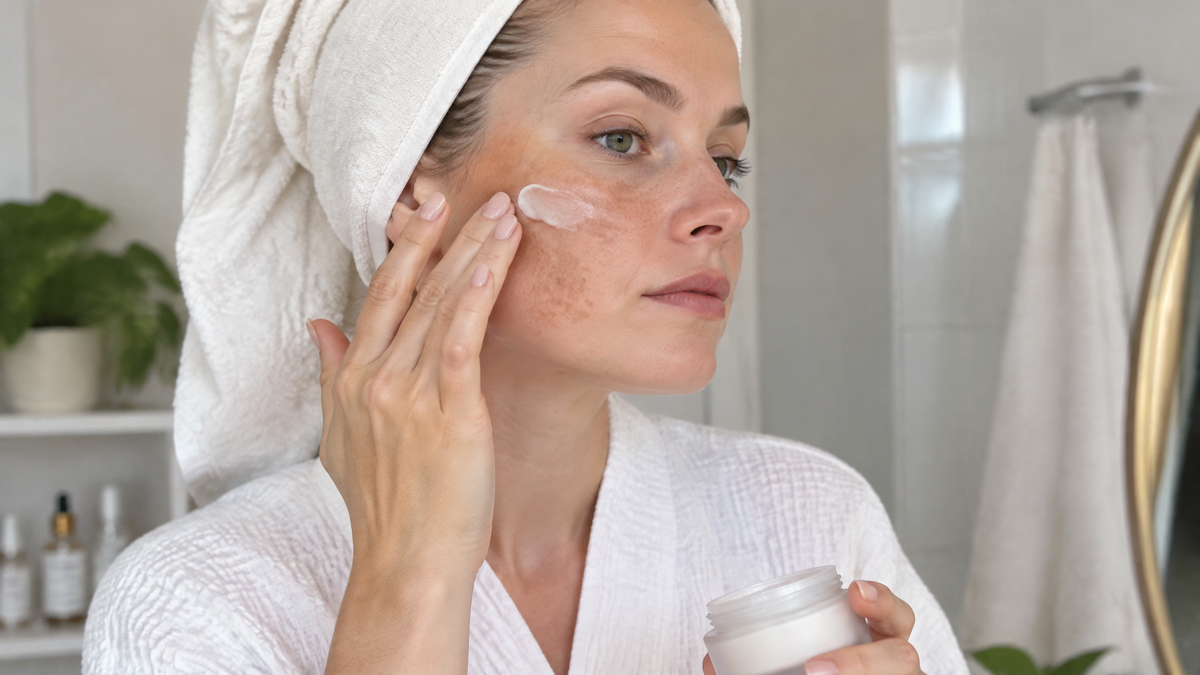
Photographing yourself at home, in your own bathroom, on your own terms, with the ability to retake an image and to write your history in your own words rather than saying it out loud — that is a materially different experience. Anecdotally, and increasingly in the literature, patients report being more forthcoming in written form about symptoms they might otherwise have minimised in a face-to-face encounter.
Continuity
Chronic skin conditions are exactly that: chronic. They require review, adjustment, and patience. A model that makes review easy encourages review. A model that makes it hard encourages people to give up mid-treatment, which is where outcomes are lost.
What a Good Photo Consultation Looks Like
If photo consultation is to be genuinely useful rather than merely fashionable, a few things need to be true.
Image quality is the foundation. Dermatology is a visual discipline. A blurry photograph taken in dim light at an awkward angle is close to useless. Good services coach you: use natural daylight, avoid direct sunlight which washes out colour, hold the camera steady, include a ruler or a coin for scale, photograph the affected area and a wider view for context, and take several images rather than one. Some platforms now use guided capture, where the app indicates whether the framing and lighting are adequate before you submit.
The history carries as much weight as the image. A photograph shows what a lesion looks like. It does not tell the clinician whether it itches, how long it has been there, whether it bleeds, what you have already tried, what medication you take, whether there is a family history. Structured questionnaires are not bureaucratic padding; they are the clinical reasoning that turns an image into a diagnosis.
The clinician is genuinely qualified. "Skincare consultation" is an unregulated phrase in many markets. The distinction between a registered prescriber and a sales assistant with a script is enormous, and it is not always obvious from a website. Look for named clinicians, visible registration numbers, and clarity about who will be reviewing your case.
There is a clear pathway for escalation. Not every concern is suitable for a photograph. Suspicious moles, rapidly changing lesions, ulceration that will not heal, anything with systemic symptoms — these need to be seen in person, often urgently. A responsible service states its limits plainly and routes people to physical care when the images or the history suggest it.
You get a written record. One underappreciated advantage of asynchronous consultation is that the output is documented. You receive a written assessment, a named diagnosis where appropriate, a treatment plan, and instructions on what to do if things do not improve. That record is yours to refer back to, and to share with another clinician if needed. In a rushed in-person appointment, much of this is spoken and promptly forgotten.
Follow-up is built in. A treatment plan without review is a guess. Good services include a follow-up window, during which you can submit new photographs and report progress.
The Limits, Stated Honestly
No honest account of photo consultation can pretend it is universally superior. It is not, and the failures are worth naming.
Some conditions simply cannot be assessed from a photograph. Texture, induration, warmth, mobility, and dermoscopic detail under magnification are difficult or impossible to capture with a phone camera. Certain diagnoses depend on palpation — on touch — and touch does not travel down a broadband connection.
Colour reproduction is unreliable. Different phone cameras, different lighting conditions, and automatic white balance all distort colour. A clinician assessing redness or pigmentation through a JPEG is working with an imperfect instrument. This is improving as capture guidance improves, but it has not been solved.
Skin of colour remains an equity problem. Diagnostic accuracy across a range of skin tones has historically been poorer in dermatology generally, and the problem does not disappear in a remote setting. Images of darker skin tones are more likely to be poorly lit or under-resolved on consumer cameras without guidance. Services that do not specifically address this are not serving all their patients equally.
Regulation varies wildly. In some jurisdictions, remote prescribing is well established with clear standards. In others, it sits in a grey area. Anyone using a photo consultation service should satisfy themselves that the clinician is properly registered where they practise, and that prescribing is lawful.
It is not an emergency service. If a lesion is changing rapidly, if there is significant pain, fever, or spreading infection, a photograph and a forty-eight-hour turnaround is the wrong tool. Emergency care is in person, and it is immediate.
Where It Fits in a Wider Shift
Photo consultation is one expression of a broader movement: the unbundling of the clinical encounter.
For most of medical history, the consultation has been a single indivisible unit. You travel; you sit; you speak; you are examined; you are advised; you leave. Every component was locked to the others because they all required physical co-presence.
Digital tools have begun to separate them. History-taking can happen asynchronously, in writing, at the patient's pace. Visual assessment can happen remotely, with better image quality than a hurried glance in a consulting room. Advice can be delivered as a document rather than a sentence. Only physical examination genuinely requires the body to be in the room — and even then, not always.
This separation is not automatically an improvement. Fragmentation has risks: care split across providers who do not talk to each other; advice given without a full picture; the substitution of convenience for rigour. But the potential is real, and it is most real for the people currently worst served — those for whom the assembled package of the traditional appointment is simply too expensive, too distant, or too intimidating to assemble at all.
Practical Advice If You Are Considering It

If you are thinking about using a photo consultation service, a few sensible steps will make the experience better.
Prepare your images properly. Natural daylight, near a window, without direct sun. A plain background. No makeup over the affected area. Take the close-up, and take a wider shot for context. Include something for scale. Take more images than you think you need — different angles, different lighting — and let the clinician choose.
Write your history carefully. When did it start? Has it changed? Does it itch, sting, or bleed? What have you already tried, for how long, and with what result? What else are you treating it with? What medication do you take? Any family history of skin disease? Be specific about timelines. Vague histories produce vague advice.
Be honest about photographs you are tempted to select. The flattering angle is not the informative one. Clinicians need to see the thing as it actually is.
Check who is reviewing. A named, registered clinician with a visible registration number is a very different proposition from an anonymous "expert."
Ask about follow-up before you pay. What happens if the treatment does not work? Is there a review window? Is there a route to a video call or an in-person referral if needed?
And know when not to use it. Rapidly changing moles, non-healing ulcers, anything with fever or systemic symptoms, severe pain — these go to a doctor in person, promptly. No convenience is worth a delay in that situation.
The Broader Point
The most persuasive argument for photo consultation is not that it is faster or cheaper, although it is often both. It is that it changes who gets seen at all.
A system that requires a person to take half a day off work, travel to a city, sit in a public waiting room, and describe a visible skin problem out loud to a stranger will systematically lose the people who cannot afford that — in money, in time, in dignity. Those losses are not evenly distributed. They fall hardest on people with the least flexibility and the most to lose.
Photo consultation does not solve dermatology's problems. It does not replace the dermatoscope, the biopsy, the careful physical examination, or the experienced clinician's eye. But it does something valuable: it moves the first step of care — the initial assessment, the triage, the decision about what this actually is and what should happen next — out of the clinic and into the places where people already are.
For someone with a chronic condition who needs regular review, it makes review possible. For someone in a rural area, it makes expertise reachable. For someone who has been avoiding care because the experience itself is humiliating, it offers a way in.
That is a meaningful change, and it is worth taking seriously — with clear eyes about its limits, and with proper attention to the standards that make it safe. Because accessibility is only worth having if what you are accessing is genuinely good.


Leave a comment
This site is protected by hCaptcha and the hCaptcha Privacy Policy and Terms of Service apply.