
Article: How to Integrate HYAL Vitamin C + E Serum into Your Daily Routine for Maximum Glow
How to Integrate HYAL Vitamin C + E Serum into Your Daily Routine for Maximum Glow
Vitamin C is one of the few skincare ingredients with decades of evidence behind it — and one of the few that most people use badly. The usual mistake isn't the product. It's the placement. Apply it at the wrong step, pair it with the wrong actives, or skip the one product that makes it work, and a genuinely good serum delivers a fraction of what it could.
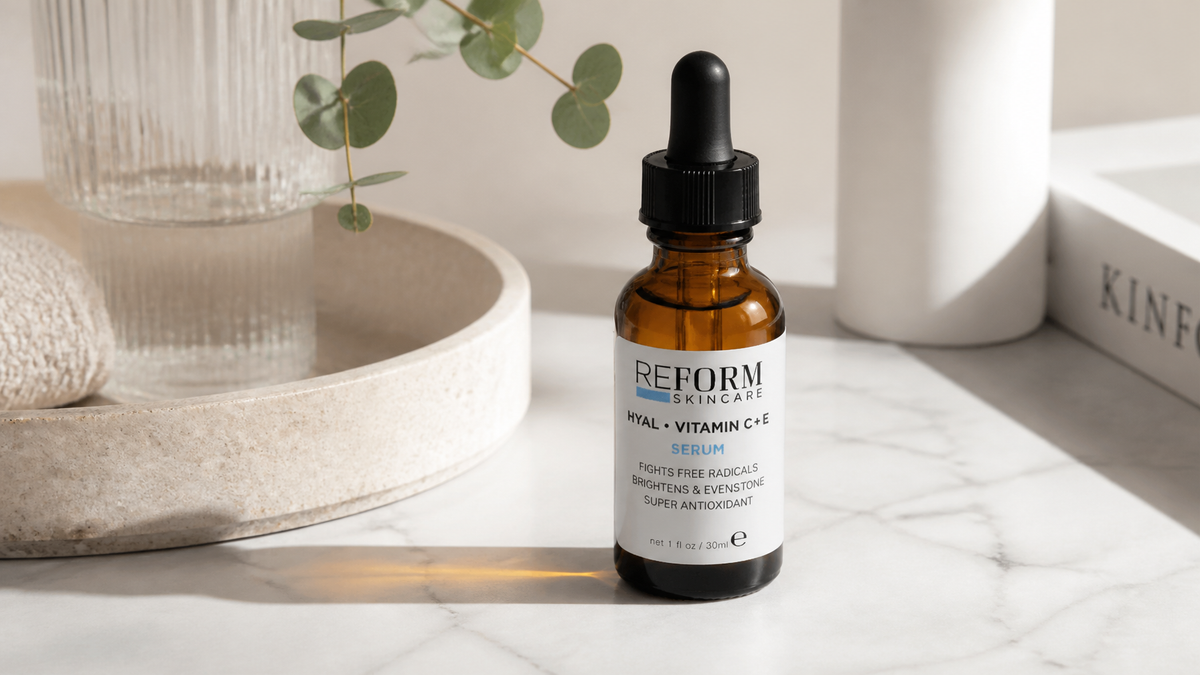
REFORM Skincare's HYAL • Vitamin C + E Serum is a case in point. It's formulated with 15% L-ascorbic acid alongside vitamin E and ferulic acid — a trio that has become the benchmark for antioxidant protection, because the three stabilise and amplify one another rather than working in isolation. Get the routine right around it and the results show up as clarity, evenness and that elusive "glow". Get it wrong and you've simply bought an expensive bottle that oxidises quietly on your shelf.
Here's how to build the routine properly.
First, understand what you're working with
HYAL is a morning serum. That isn't a stylistic preference — it's chemistry.
L-ascorbic acid is an antioxidant. Its job is to neutralise the free radicals generated by UV exposure, pollution and everyday environmental stress before they go on to break down collagen and trigger excess pigment production. Applying it before you go out means it's sitting in the skin, ready, when the day's exposure begins. Applying it at night means the exposure has already happened.
The supporting cast matters just as much. Vitamin E (tocopherol) is a lipid-soluble antioxidant that works in a different part of the cell, and ferulic acid does two things at once: it stabilises the vitamins against breakdown and adds antioxidant capacity of its own. Together they extend how long the formula stays effective on the skin and how long it stays effective in the bottle.
Two practical consequences follow from that:
It needs a dark, cool, closed home. L-ascorbic acid oxidises on contact with light and air. A bottle that has turned deep amber or brown has oxidised, and an oxidised serum is largely inert. Keep the lid tight, keep it out of direct sunlight, and don't decant it into a clear pump bottle for aesthetic reasons.
It needs your skin to be dry. Water on the skin dilutes the formula and shifts its pH, which affects how well the acid penetrates. Wait a minute after cleansing, and pat dry rather than leaving the skin damp.
The morning routine, step by step
The order is not arbitrary — it runs from thinnest to thickest, and from actives to occlusives. Each layer should be absorbed before the next goes on, or you'll simply be pushing product around your face.
1. Cleanse. A gentle cleanse is enough in the morning. If you have used a stronger active overnight, you don't want to strip the barrier again at 7am. REFORM's Gentle Hydrating Crème Cleanser suits most skin types here — it removes what accumulated overnight without leaving the skin tight. If you're oily or blemish-prone, their Salicylic Acid Foaming Cleanser is a reasonable alternative, but use it as your only cleanse of the day rather than doubling up.
2. Wait for dry skin. Thirty to sixty seconds. This is the step everyone skips and the one that most affects how well the serum performs.
3. Apply HYAL. Two to three drops is the stated dose, and it is genuinely enough — this is a leave-on active, not a moisturiser to be layered generously. Warm the drops between your fingertips, then press and massage upward and outward across the face, neck and décolletage. The neck and chest are where sun damage accumulates most visibly and are the areas most often forgotten. Avoid the immediate eye area; the skin there is thin and the formula is strong.
4. Give it a minute. Let it absorb fully before moving on.
5. Moisturise. Vitamin C supports the skin but doesn't hydrate it in a meaningful way, and a well-functioning barrier is what allows actives to work without irritation. If your skin is normal to dry, REFORM's Intensive Moisturiser gives you a richer layer. If you're oilier or prefer something lighter under makeup, their Everyday Moisturiser is the better fit. Either way, this step is not optional — it's what keeps a 15% acid tolerable day after day.
6. Sunscreen. Always. This is the non-negotiable one. Vitamin C is a supporting act for sun protection, never a replacement for it. A broad-spectrum SPF of at least 30, applied properly and reapplied through the day, is what protects the results you're building — and it's what makes the brightening effect visible in the first place. REFORM's SPF 50+ Antioxidant Sunscreen is designed to sit on top of this routine without pilling, which is a small thing that matters more than it sounds when you're layering three products before 8am.
That's the whole morning: cleanse, dry, HYAL, moisturise, SPF. Five steps, roughly ninety seconds once you've done it a few times.
What to avoid pairing with it
L-ascorbic acid is acidic and at 15% it is doing real work. That means a few combinations need care.
Skip the exfoliating acids immediately before it. Glycolic and salicylic acids lower the skin's pH and remove surface cells; layering vitamin C straight on top can push a sensitive skin into stinging, redness and flaking. If you use REFORM's Glycolic Acid Foaming Cleanser, use it in the evening, on days when your skin feels resilient, and not as a prelude to your morning serum.
Don't stack it directly with retinol. Retinol belongs at night, for reasons of both stability and tolerability. There's no benefit to applying both within the same few minutes. The cleanest approach — and the one that gets the most out of both — is vitamin C in the morning, retinol at night, with no overlap. If you're introducing REFORM's Retinol 1% Creme, add it gradually, two nights a week to begin, and drop to one morning of vitamin C a week if you notice irritation while your skin adjusts.
Be cautious with benzoyl peroxide. It oxidises vitamin C on contact, which is a waste of both products. Alternate rather than layer.
The evening routine, briefly
Your evenings don't need vitamin C, but they do need to support what the mornings are doing.
Cleanse properly — if you wore SPF, this is a full removal, not a splash of water.
Treat, if you're treating. Retinol, or the Repair & Renew Gel if you're pursuing a gentler renewal approach. Never both on the same night.
Moisturise. Same logic as the morning. If your skin feels reactive or tight — common when you're new to regular vitamin C — REFORM's Skin Barrier Repair Cream is the more supportive choice while things settle.
Alternating rather than stacking is the guiding principle. Mornings are for protection and brightening. Evenings are for repair and renewal. The two don't need to compete.
Getting the glow: realistic timelines
This is where most people give up too early, and where honest expectations are worth more than any marketing claim.
Weeks 1–2: Nothing dramatic. Possibly a little tingling on first application, which should settle within a minute or two. Some people notice a slightly tighter, brighter quality to the skin. Mostly, this is your skin adapting.
Weeks 3–6: Early pigmentation changes become visible. Post-blemish marks start to fade, and the overall tone looks more even. This is the point at which people who take progress photos notice something they can't quite name.
Weeks 8–12: This is the real payoff window. Collagen support and pigment regulation are slow processes, and this is when firmness, clarity and that reflective quality people call "glow" become genuinely apparent — to you and to others.

Consistency beats intensity throughout. Five mornings a week for three months will do more than a fortnight of obsessive application followed by abandonment. And if your skin is sensitive, starting at every other morning for the first two weeks costs you nothing in the long run and substantially reduces the chance you'll have to stop entirely.
The common mistakes, in one place
Applying to damp skin, which dilutes the formula. Using too much, which wastes it and increases irritation without improving results. Applying it at night, when the day's exposure has already passed. Skipping sunscreen, which undoes the protection you just paid for. Storing the bottle somewhere bright and warm. Layering it directly with retinol or exfoliating acids on a skin that isn't ready. Abandoning it at four weeks, just before it starts working.
Every one of those is easy to fix, and none of them are about the product being wrong.
The short version
Use HYAL • Vitamin C + E Serum in the morning, on clean dry skin, before your moisturiser and always before sunscreen. Two to three drops, face, neck and chest. Give it a minute to absorb. Keep the bottle dark and sealed. Keep retinol and exfoliating acids for the evening. Be patient for eight to twelve weeks.
The glow isn't a secret ingredient. It's a good formula, in the right place, done consistently — and protected every single day by the SPF that makes all of it worth doing.


Leave a comment
This site is protected by hCaptcha and the hCaptcha Privacy Policy and Terms of Service apply.