
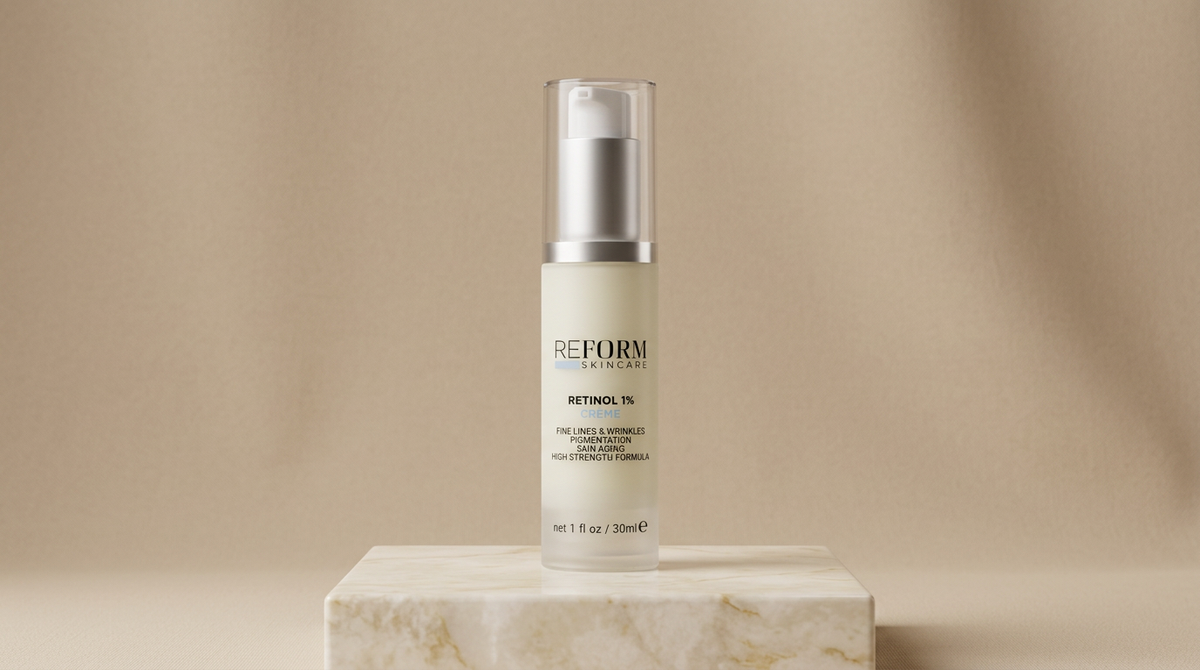
High-Strength Skin Renewal: Is Retinol 1% Creme Right for You?
Retinol is one of skincare’s most established ingredients for addressing visible signs of ageing, uneven pigmentation and rough texture. But while low-strength formulas are widely available, a 1% retinol creme sits at the more intensive end of the spectrum. It may deliver impressive results, but it also requires patience, careful application and a routine that protects the skin barrier.
So, who is high-strength retinol suitable for, and how can you introduce it safely?
What is retinol?
Retinol is a vitamin A derivative used in topical skincare. Once applied, it is converted within the skin through several stages into retinoic acid, the active form that influences skin-cell behaviour.
With consistent use, retinol can help:
- Improve the appearance of fine lines and wrinkles
- Support smoother, more refined-looking skin
- Reduce the appearance of dark spots and uneven tone
- Encourage clearer-looking pores
- Improve skin firmness and overall radiance
These changes do not happen overnight. Retinol works gradually, and visible improvement usually depends on regular use over several weeks or months.
What does 1% retinol mean?
A 1% retinol formula is generally considered high strength in cosmetic skincare. It is not necessarily ten times more effective than a 0.1% product, nor will it produce results ten times faster. Concentration is only one part of the formula: stability, delivery system, supporting ingredients and packaging can all affect performance.
Higher strength also means a greater possibility of irritation. Redness, tightness, dryness, flaking and temporary sensitivity are common signs of retinisation - the adjustment period that can occur when the skin is first exposed to retinol.
Some mild dryness may be manageable. Persistent burning, swelling, cracking or painful inflammation, however, is not something to push through.
Who may benefit from Retinol 1% Creme?
A high-strength product is usually better suited to an experienced retinol user rather than a complete beginner. You may be a suitable candidate if:
- You have already used a lower-strength retinol consistently without significant irritation.
- Your main concerns include established fine lines, sun-related pigmentation or uneven texture.
- Your skin barrier is healthy and relatively resilient.
- You are willing to introduce the product gradually.
- You use broad-spectrum sunscreen every day.
REFORM Skincare describes its Retinol 1% Creme as a rich creme formulation intended to improve the appearance of ageing, skin texture and dark spots. Its strength makes it a considered treatment rather than a product to add casually to an already active routine. REFORM Skincare
Who should approach it cautiously?
A 1% retinol formula may be too strong if you are new to vitamin A, have highly reactive skin or are already experiencing barrier damage. Extra caution is advisable for people with eczema, rosacea or other inflammatory skin conditions.

Retinol should not be applied to broken, sunburnt or severely irritated skin. It may also be unsuitable alongside certain prescription treatments or after professional procedures such as chemical peels, laser treatments or microneedling unless a qualified clinician has advised otherwise.
Retinoids are commonly avoided during pregnancy, and professional guidance is advisable when breastfeeding. If you have a skin condition, take medication affecting the skin or are uncertain about compatibility, speak to a GP, dermatologist or other suitably qualified professional.
How to introduce 1% retinol
Even experienced users should treat a new high-strength formula carefully.
1. Patch test first
Apply a small amount to an inconspicuous area and monitor the skin before using it across the face. A patch test cannot predict every reaction, but it may reveal obvious sensitivity.
2. Begin slowly
Start with one evening a week. If your skin remains comfortable, increase to twice weekly, leaving several nights between applications. Do not move towards more frequent use until the skin has adjusted.
Daily application is not automatically better. The best frequency is the one your skin can tolerate consistently.
3. Use only a small amount
A pea-sized quantity is normally enough for the entire face. Applying a thicker layer does not accelerate renewal; it mainly increases the risk of irritation.
Avoid the eyelids, corners of the nose, lips and any particularly sensitive areas unless the product’s directions specifically state otherwise.
4. Apply to dry skin
After cleansing, allow the skin to dry fully before applying retinol. Damp skin may increase penetration and make irritation more likely.
Those prone to dryness can use the sandwich method: apply a light layer of moisturiser, follow with retinol, then finish with another layer of moisturiser.
5. Keep the rest of the routine simple
On retinol nights, use a gentle cleanser and a comfortable moisturiser. A product designed to support the skin barrier can be useful if dryness develops, but introducing several new products at once makes it harder to identify the cause of a reaction.
Ingredients to avoid on the same evening
High-strength retinol does not always combine comfortably with other powerful actives. During the adjustment period, avoid layering it in the same routine with:
- Glycolic, lactic or salicylic acid
- Exfoliating scrubs or peels
- Benzoyl peroxide
- Other retinoids
- Strong or irritating treatments
This does not mean these ingredients must be abandoned permanently. Once your skin is stable, they may be used on alternate nights if tolerated. The priority is to avoid overwhelming the skin.
Sunscreen is non-negotiable
Retinol is an evening treatment, but the success of the routine depends heavily on what happens the next morning. Daily broad-spectrum sunscreen helps protect the skin from UV damage and prevents existing pigmentation from becoming darker.
Use an SPF of at least 30, apply it generously and reapply when appropriate - particularly after swimming, sweating or prolonged outdoor exposure. REFORM Skincare offers several sunscreen options, but the essential point is to choose a broad-spectrum formula you are comfortable wearing every day. REFORM Skincare
No retinol can compensate for regular unprotected sun exposure.
When can you expect results?
Some people notice smoother-feeling skin within several weeks, but changes in fine lines and pigmentation usually take longer. A realistic assessment often requires three to six months of consistent, well-tolerated use.
Early dryness can make the complexion appear temporarily worse. This does not mean that severe irritation is necessary for the product to work. Retinol should create gradual improvement, not continual discomfort.
Take photographs in similar lighting every four weeks rather than inspecting the skin daily. This makes subtle changes easier to recognise and reduces the temptation to increase usage too quickly.
Is Retinol 1% Creme right for you?
It may be appropriate if you already tolerate retinol, want a more intensive approach to visible ageing or pigmentation, and can commit to gradual introduction, moisturisation and daily sun protection.
It is probably not the best starting point if you have never used retinol, have very sensitive or compromised skin, frequently skip sunscreen or already use several strong active treatments.
The most effective retinol is not necessarily the strongest one. It is the formula you can use consistently without repeatedly damaging your skin barrier. For experienced users, a carefully introduced 1% retinol creme may be a valuable step forward. For beginners, starting lower and building tolerance is usually the wiser route.


Leave a comment
This site is protected by hCaptcha and the hCaptcha Privacy Policy and Terms of Service apply.