
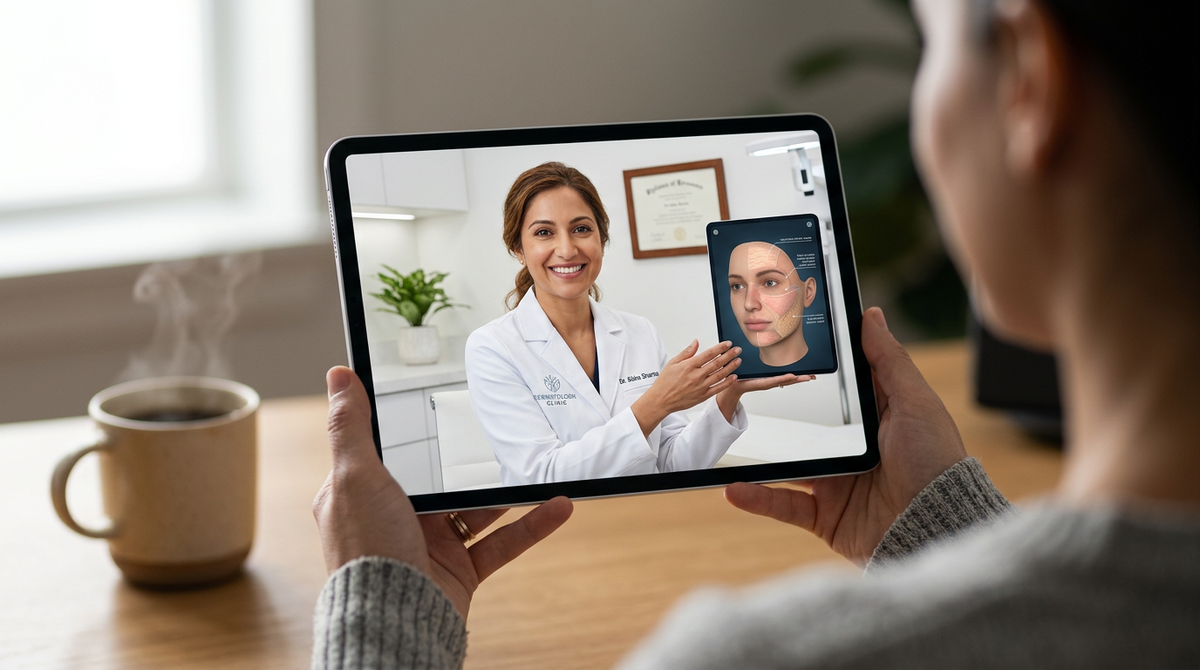
Why Virtual Consultation Is the Fastest Way to Get Answers About New Moles
Discovering a new mole can be unsettling. You may wonder whether it has always been there, whether it looks unusual or whether you should arrange a medical appointment. Searching online can quickly add to the uncertainty because photographs and symptom lists cannot tell you what is happening on your skin.
A virtual consultation offers a faster, more reliable first step. By sharing clear images and relevant information with a qualified healthcare professional, you can receive personalised guidance without waiting for a traditional clinic appointment.
Quick access to professional advice
The main advantage of a virtual consultation is convenience. Instead of arranging travel, taking time away from work or waiting for an available face-to-face appointment, you can begin the assessment from home.
Depending on the service, you may complete an online form, upload photographs and attend a video appointment. A clinician can review when the mole appeared, whether it has changed and whether you have experienced symptoms such as itching, pain, bleeding or crusting.
This does not mean every mole can be diagnosed through a screen. It does mean that a professional can often advise you quickly on the most appropriate next step.
It replaces guesswork with individual guidance
Most moles are harmless, but it is not always easy to distinguish an ordinary mole from a mark that needs closer examination. Comparing your skin with pictures online can be misleading because harmless and concerning lesions do not always follow a textbook appearance.
During a virtual assessment, the clinician can consider factors that an image search cannot, including:
- When the mole appeared and whether it is genuinely new.
- How it has evolved, including changes in size, shape, colour or texture.
- Whether it feels different, such as becoming painful, itchy or tender.
- Your personal history, including sun exposure, previous skin cancer and family history.
- How it compares with your other moles, particularly if it looks noticeably different.
This context helps the clinician decide whether monitoring is reasonable or an in-person examination should be arranged.
Photographs create a useful record
One of the most useful parts of a virtual consultation is the photographic record. A clear, well-lit image captures how the mole looks at a particular point in time. If monitoring is advised, future photographs can help reveal subtle changes that may otherwise be difficult to remember.
For the clearest photographs:
- Take one image showing where the mole is located on the body.
- Take a closer photograph that shows its shape, border and colour.
- Use bright, natural light and make sure the image is in focus.
- Include a ruler beside the mole when possible to indicate scale.
- Avoid filters, make-up and image editing.
Photographs should support professional assessment rather than replace it. Some lesions require examination with a dermatoscope, a specialist magnifying instrument used to see structures beneath the skin's surface. A biopsy may occasionally be necessary to reach a definite diagnosis.
Virtual triage can speed up the next step

A virtual consultation is particularly valuable as a triage tool. If the mole appears reassuring, the clinician may explain how to monitor it and what changes should prompt another review. If it has concerning features, they can recommend a timely face-to-face appointment or referral.
This avoids two common problems: delaying medical advice because arranging an appointment feels inconvenient, and spending weeks worrying about a mole that may not require urgent intervention.
The NHS advises seeing a GP if a mole changes size, shape or colour; becomes painful, itchy, inflamed, bleeding or crusty; or if a new or unusual mark has not disappeared after a few weeks. Early assessment matters because melanoma is generally easier to treat when found early.
What should you look for?
The ABCDE guide is a useful way to recognise possible warning signs:
- A - Asymmetry: One half does not match the other.
- B - Border: The edges appear irregular, blurred or uneven.
- C - Colour: The mole contains several colours or has changed colour.
- D - Diameter: It is getting larger, although concerning melanomas can also be small.
- E - Evolving: It is changing in size, shape, colour, elevation or sensation.
Another helpful warning sign is the "ugly duckling" - a mole that looks different from the others on your body. However, these guides are not diagnostic tests. A lesion does not need to meet every criterion to deserve medical attention.
When virtual assessment is not enough
Virtual consultations are fast, but they have limits. Image quality, lighting and camera angle can affect what the clinician sees, while certain features are only visible through dermoscopy or physical examination.
Arrange prompt medical advice if a mole is rapidly changing, repeatedly bleeding, persistently painful or markedly different from your other moles. You should also seek an in-person examination if the clinician recommends one, even if the mole does not seem worrying to you.
Do not attempt to remove, bleach, exfoliate or treat a new mole with skincare products. Doing so can irritate the area, alter its appearance and delay proper assessment.
Prevention remains part of good skin care
A virtual consultation helps assess a mole that has already appeared; it does not replace everyday sun protection. Reducing ultraviolet exposure supports long-term skin health and lowers the risk of preventable skin damage.
Use a broad-spectrum sunscreen, seek shade during periods of strong sunlight and wear protective clothing. REFORM Skincare's sun-protection range includes options such as SPF 50+ Antioxidant Sunscreen, SPF 30 Mineral Sunscreen and SPF 50+ Tinted Sunscreen, allowing you to choose a format suited to your routine. Sunscreen should be applied generously and reapplied regularly, but it cannot diagnose, treat or remove a mole.
Regular self-checks are equally important. Examine your skin in good light every month or so, including areas that are easy to overlook, such as the scalp, back, soles of the feet and between the toes. Ask someone you trust to help check places you cannot see clearly.
Fast answers can bring clarity
A virtual consultation offers something an internet search cannot: advice based on your photographs, symptoms and personal circumstances. It can help you understand whether a new mole should be monitored, examined in person or referred for specialist review.
Its greatest benefit is not simply speed, but speed with direction. Rather than watching and worrying, you receive a clear next step. When a mole is new, changing or simply causing concern, arranging a qualified medical assessment is always more useful than trying to diagnose it yourself.


Leave a comment
This site is protected by hCaptcha and the hCaptcha Privacy Policy and Terms of Service apply.