

Psoriasis Management: Beyond Topical Steroids to Advanced Care
For decades, the standard playbook for anyone diagnosed with psoriasis was painfully predictable. You noticed a patch of thick, red skin covered with silvery scales. You went to the doctor, and you walked out with a tube of topical steroid cream. For mild, isolated patches, that tube was—and still is—a lifesaver.
But for millions of people living with moderate-to-severe psoriasis, relying solely on topical steroids feels like trying to put out a house fire with a garden hose.
The underlying issue is that psoriasis is vastly misunderstood. It is frequently written off as a mere "skin condition." In reality, the plaques on the surface are just the external symptoms of a highly complex, systemic inflammatory disease.
Fortunately, the landscape of dermatology has completely transformed. We have moved far beyond the era of simply greasing the skin. Today, advanced care target-fixes the immune system itself. Let’s break down why it’s time to look past the tube of steroid cream and what modern, advanced psoriasis management actually looks like.
The Ceiling of Topical Steroids
Topical corticosteroids have been the bedrock of psoriasis treatment for generations. They work by suppressing local immune responses and reducing swelling and redness. However, they are fundamentally designed as short-term, localized patches—not long-term, comprehensive solutions.
When overused or applied to large areas of the body, topical steroids hit a definitive therapeutic ceiling and introduce significant risks:
-
Skin Atrophy: Chronic use thins the skin, making it fragile, easily bruised, and prone to stretch marks.
-
Tachyphylaxis: This is the medical term for tolerance. Over time, your skin stops responding to the steroid, requiring stronger and higher potencies to achieve the exact same effect.
-
Rebound Flares: Suddenly stopping a high-potency topical steroid can shock the immune system, triggering a severe flare-up that is often worse than the initial outbreak.
-
Systemic Absorption: If applied over large surface areas, the medication can absorb into the bloodstream, potentially interfering with your body's natural hormone production (the adrenal axis).
If more than 5% to 10% of your body surface area is affected, applying creams daily becomes physically exhausting and clinically insufficient. Psoriasis is an inside-out problem; it demands an inside-out solution.
The Big Picture: Psoriasis as a Systemic Disease

To understand why advanced treatments are necessary, we have to look beneath the epidermis. In a healthy body, skin cells grow and flake off over the course of roughly a month. In a body with psoriasis, an overactive immune system sends faulty signals that accelerate this lifecycle to just a few days. The body cannot shed the cells fast enough, causing them to pile up into raised, painful plaques.
Because this inflammation circulates throughout the entire body, psoriasis is deeply intertwined with several systemic health complications, collectively known as comorbidities:
Psoriatic Arthritis (PsA): Up to 30% of people with psoriasis will develop this chronic inflammatory arthritis, which causes irreversible joint damage, pain, and stiffness if left untreated.
Cardiovascular Disease: Chronic systemic inflammation damages blood vessels. People with severe psoriasis have a significantly elevated risk of heart attacks and strokes.
Metabolic Syndrome: There is a strong statistical link between psoriasis, type 2 diabetes, obesity, and high cholesterol.
Advanced care isn't just about achieving clear skin; it is about mitigating these hidden, systemic risks.
Enter the Biologics: Precision Immune Targeting
The absolute crown jewel of modern psoriasis management is the development of biologics. Unlike traditional systemic medications that broadly suppress the entire immune system, biologics are highly targeted engineered proteins. They act like smart bombs, zeroing in on the exact cellular messengers—called cytokines—that drive the inflammatory cascade in psoriasis.
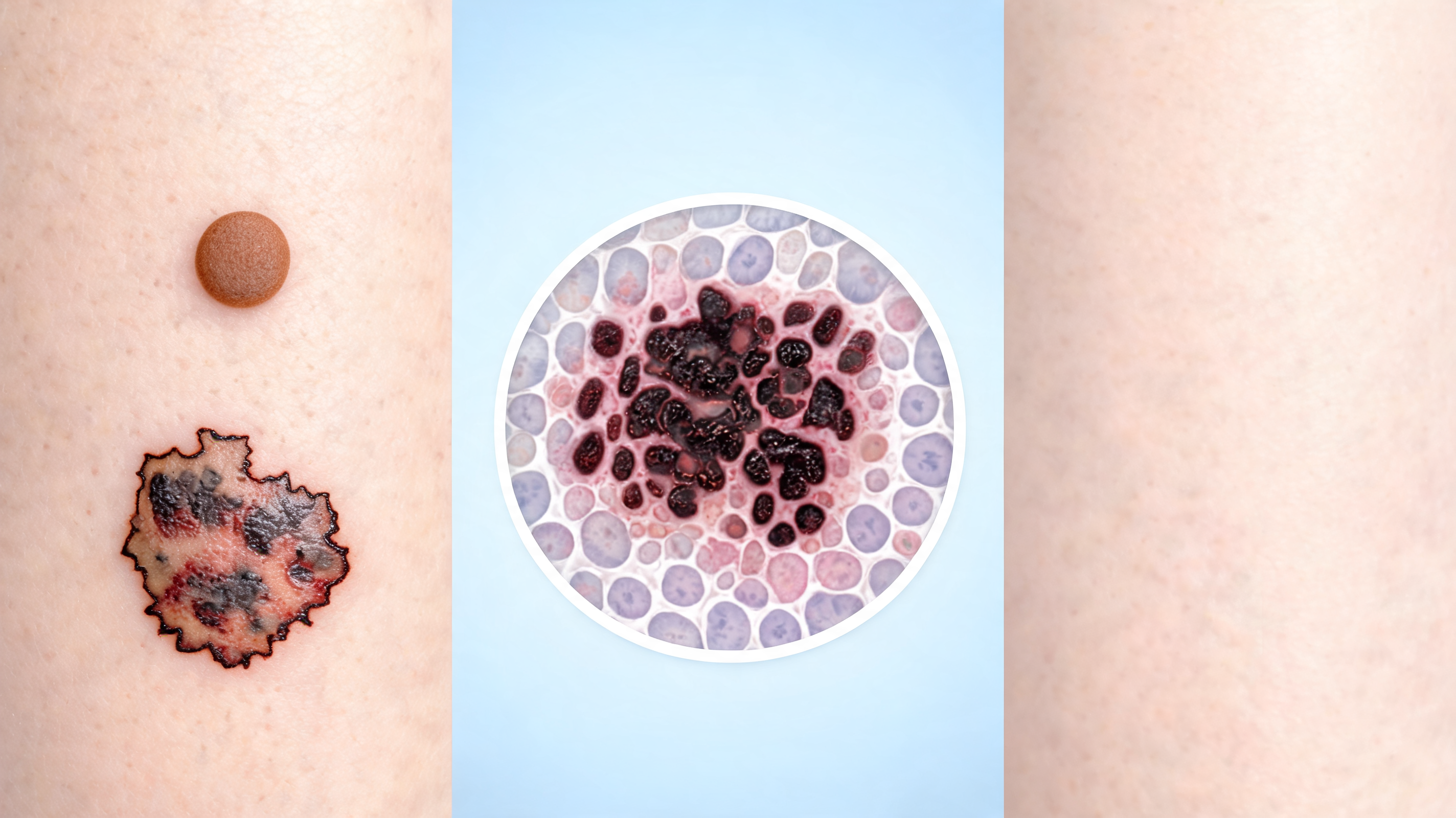
As shown in the cellular pathway diagram above, modern medicine can now isolate and block the precise proteins causing the chaos. The primary families of biologics include:
1. Interleukin-23 (IL-23) Inhibitors
-
How they work: IL-23 is considered a "master regulator" cytokine upstream in the inflammatory process. By blocking it, these drugs stop the signal before it ever instructs the skin cells to hyper-proliferate.
-
Examples: Guselkumab, Risankizumab, Tildrakizumab.
-
The Benefit: Unprecedented clearance rates. Many patients achieve PASI 90 or PASI 100 (meaning 90% to 100% completely clear skin) with doses required only once every few months.
2. Interleukin-17 (IL-17) Inhibitors
-
How they work: IL-17 is a cytokine downstream that directly causes the visible tissue inflammation, redness, and scaling.
-
Examples: Secukinumab, Ixekizumab, Brodalumab.
-
The Benefit: Exceptionally rapid onset. Patients often notice a massive reduction in plaque thickness and scaling within the first two weeks of starting treatment.
3. Tumor Necrosis Factor (TNF) Inhibitors
-
How they work: The oldest class of biologics, targeting a broad inflammatory protein called TNF-alpha.
-
Examples: Adalimumab, Etanercept, Infliximab.
-
The Benefit: While slightly less skin-specific than IL-17 or IL-23 blockers, they are profoundly effective at managing concurrent psoriatic arthritis, protecting joint health alongside skin health.
Small Molecule Oral Medications: The Modern Pill
For those who are squeamish about the self-injections required by most biologics, advanced care has also revolutionized oral therapy. Traditional pills like methotrexate or cyclosporine require intense routine blood monitoring because they broadly suppress the liver, kidneys, and immune system.
The new generation of oral treatments consists of small molecule inhibitors. These are targeted pills that alter specific intracellular pathways without the sweeping side effects of older systemics:
-
PDE4 Inhibitors (Apremilast): This daily pill blocks an enzyme called phosphodiesterase 4, helping regulate inflammation inside cells. It requires no baseline lab monitoring and is highly effective for mild-to-moderate cases.
-
TYK2 Inhibitors (Deucravacitinib): A newer class of once-daily medication that selectively blocks Tyrosine Kinase 2, a key signaling enzyme for psoriasis pathways. It delivers biologic-like efficacy with the convenience of a pill.
Phototherapy: Harnessing Light Realistically
Advanced care isn't solely pharmacological. Light therapy has evolved far past natural sunbathing. Modern Narrowband UVB phototherapy utilizes precise wavelengths of light ($311\text{ nm}$) that shut down overactive immune cells in the skin without exposing the patient to the harmful, burning UVA rays of the sun or tanning beds.
While traveling to a clinic three times a week used to be a major barrier, home-based medical phototherapy booths are now widely covered by insurance, allowing patients to administer precise, dermatologist-calibrated light doses in their own bedrooms.
Creating a Holistic, Advanced Management Matrix
True modern care recognizes that medication is only half the battle. Because psoriasis is fundamentally tethered to metabolic and systemic health, an advanced treatment plan must look at lifestyle through an inflammatory lens.
| Management Pillar | Strategic Action | Biological Impact |
| Advanced Therapy | Transition to Biologics or TYK2 Inhibitors | Direct cellular blockade of IL-17, IL-23, or signaling pathways. |
| Metabolic Care | Cardiovascular screening and lipid management | Offsets the inherent stroke and heart disease risks linked to systemic flares. |
| Anti-Inflammatory Diet | High Omega-3s, low refined sugars, minimized alcohol | Reduces the baseline systemic "fire" that makes skin more reactive to triggers. |
| Stress Reduction | Mindfulness, nervous system regulation | Cortisol spikes directly trigger mast cells, launching sudden skin flares. |
Choosing Your Next Steps
If you are currently trapped in a cycle of applying heavy, greasy creams, watching your skin clear up for a week, and then experiencing a massive flare the moment you stop, please know that you do not have to live this way.
The standard of success in dermatology has shifted. We are no longer settling for "a little less itchy." The goal of modern advanced care is total, long-lasting skin clearance and the preservation of your internal joint and heart health.
Schedule an open, honest conversation with a dermatologist. Ask them flat out: "Am I a candidate for advanced systemic therapy or biologics?" It is time to step past the topical creams and take control of your health from the inside out.


1 comment
Really informative post! Raising awareness about alternative and advanced care options for skin conditions like psoriasis is so important. Very helpful write-up.
see
Nandita
Leave a comment
This site is protected by hCaptcha and the hCaptcha Privacy Policy and Terms of Service apply.