
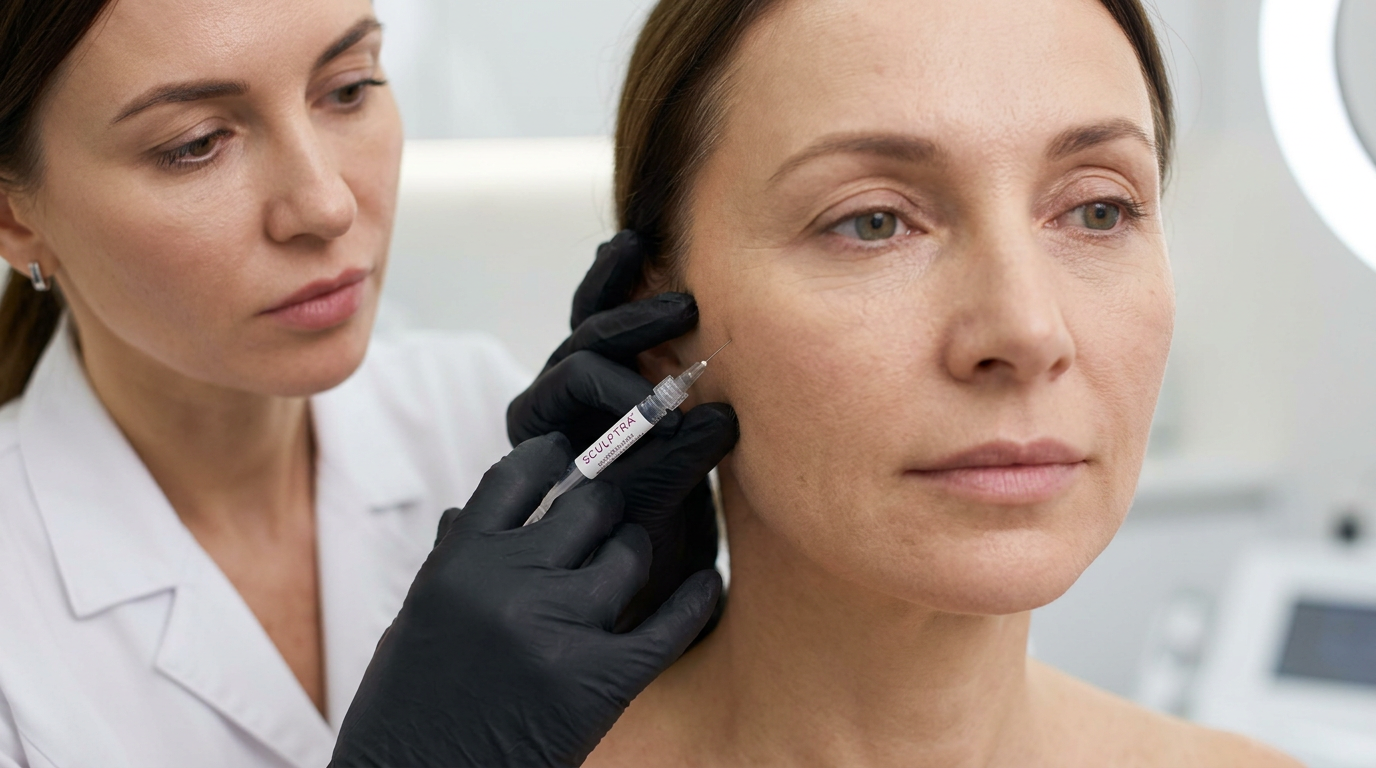
How Sculptra Works with Your Body to Rebuild Lost Collagen
The Invisible Architecture Beneath Your Skin
There's a reason your skin looked effortlessly plump and smooth in your twenties. Beneath the surface, a dense scaffolding of collagen — the most abundant protein in the human body — held everything together. It gave your cheeks their volume, your jawline its definition, and your skin that unmistakable bounce.
But starting in your mid-twenties, your body begins producing roughly 1% less collagen each year. By the time you reach your forties and fifties, the cumulative loss becomes visible: hollowed temples, flattened cheeks, deepening folds around the nose and mouth, and skin that simply doesn't spring back the way it used to. This isn't damage in the traditional sense — it's a slow structural withdrawal happening at the deepest layers of your dermis.
Most cosmetic treatments address the appearance of this loss. Sculptra addresses the cause.
What Sculptra Actually Is
Sculptra (poly-L-lactic acid, or PLLA) is an FDA-cleared injectable biostimulator. Unlike traditional dermal fillers that add volume by physically occupying space beneath the skin, Sculptra works by triggering your body's own collagen-production machinery. The distinction matters more than most people realize, because it changes everything about how the results look, develop, and last.
Poly-L-lactic acid isn't new or experimental. It's a biocompatible, biodegradable synthetic polymer that has been used in dissolvable sutures and medical implants for decades. When formulated as Sculptra and injected into the deep dermis or subcutaneous layer, the microparticles of PLLA set off a carefully controlled biological response — one that gradually replaces lost collagen with your own, newly produced collagen.
The result isn't something that's been added to your face. It's something your face rebuilt.
The Science: A Three-Phase Biological Process
Understanding how Sculptra works means understanding how your body responds to it over time. The process unfolds in three overlapping phases.
Phase 1 — The Initial Response
When Sculptra is injected, the PLLA microparticles are suspended in sterile water and a small amount of carboxymethylcellulose (a carrier gel). The water provides immediate but temporary volume — this is why patients sometimes notice subtle fullness right after treatment. Over the first few days, the water is absorbed by the body, and the initial volume diminishes. This is completely expected and isn't a sign the treatment failed.
What remains are the PLLA microparticles, now distributed within the deep layers of the skin.
Phase 2 — The Biostimulatory Cascade
This is where the real work begins. Your immune system recognizes the PLLA microparticles as foreign — but non-threatening. The body mounts a subclinical inflammatory response, dispatching specialized cells called fibroblasts and macrophages to the injection sites.
Macrophages attempt to break down the PLLA particles. In doing so, they release signaling molecules (cytokines and growth factors) that recruit fibroblasts to the area. Fibroblasts are the cells directly responsible for producing collagen. As they arrive and activate, they begin laying down new type I and type III collagen fibers — the same types that make up the structural framework of youthful skin.
This isn't a one-time event. The process is gradual and sustained, which is why Sculptra's results emerge slowly over weeks and months rather than appearing overnight. The PLLA particles act as a scaffold, giving the fibroblasts a structure to build around. Think of it like lattice work in a garden — the lattice itself isn't the plant, but it directs where and how growth occurs.
Phase 3 — Remodeling and Maturation
Over the course of several months, the PLLA microparticles are fully hydrolyzed — broken down into lactic acid, carbon dioxide, and water, all of which are naturally metabolized by the body. But by the time the particles disappear, they've done their job. The new collagen matrix they stimulated remains in place.
This new collagen continues to mature and remodel for up to two years after treatment. The fibers cross-link and organize, gaining strength and structure. The result is restored volume and improved skin texture that looks and feels natural — because it literally is your own tissue.
Why the Gradual Timeline Is Actually an Advantage
In a culture accustomed to instant results, the idea of waiting months for a cosmetic treatment to fully develop can feel counterintuitive. But Sculptra's gradual onset is one of its greatest strengths.

Because the volume builds slowly, the change is subtle and progressive. People around you won't notice that you "had something done." They'll notice that you look rested, healthy, and refreshed — without being able to pinpoint why. There's no sudden shift from one appointment to the next. Instead, your reflection in the mirror improves a little more each week, tracking naturally with how collagen actually behaves in living tissue.
This gradual approach also means the results integrate seamlessly with your existing facial anatomy. Rather than sitting on top of your natural structure the way a filler does, the new collagen weaves itself into the surrounding tissue. The outcome moves with your expressions, ages with your face, and avoids the "overfilled" look that can occur with volumizing fillers when they're used aggressively.
What a Typical Treatment Plan Looks Like
Sculptra isn't a one-and-done treatment. Most patients require two to three sessions, spaced about four to six weeks apart. This staged approach allows the practitioner to assess how your body is responding and to build volume conservatively, layering results with precision.
During each session, the product is injected using a needle or cannula into targeted areas — commonly the temples, cheeks, jawline, and chin. After injection, the treated areas are thoroughly massaged. Patients are typically instructed to follow the "5-5-5" rule: massage the treated areas for five minutes, five times a day, for five days after each session. This helps distribute the product evenly and reduces the risk of nodule formation.
The full effect of the treatment plan becomes visible roughly three to six months after the final session, as the collagen matrix reaches its peak density.
How Long Do Results Last?
This is where Sculptra distinguishes itself most dramatically from traditional fillers. While hyaluronic acid fillers typically last 6 to 18 months before being metabolized, clinical studies have shown that Sculptra's results can last more than two years — with some patients reporting sustained improvement beyond that.
The longevity makes sense when you consider what's actually happening. A hyaluronic acid filler is a material that your body gradually breaks down and absorbs. Once it's gone, the volume is gone. With Sculptra, the injected material is also absorbed — but it leaves behind a legacy of new collagen. You're not maintaining an implant; you're benefiting from tissue your body built itself.
That said, collagen loss doesn't stop. Aging continues, and the natural decline in collagen production means that maintenance sessions — typically once a year or every other year — can help sustain results over time.
Who Is a Good Candidate?
Sculptra is best suited for individuals experiencing volume loss and skin laxity due to aging, rather than those looking to dramatically alter facial proportions or fill deep, isolated lines. Ideal candidates are typically in their mid-thirties to sixties and want a natural-looking restoration of facial fullness.
It's also an excellent option for people who prefer a preventive, long-game approach to facial aging — investing in their skin's structural health rather than chasing quick fixes.
Sculptra is not recommended for use in the lips or directly around the eyes, and it isn't appropriate for people with active skin infections or certain autoimmune conditions. A thorough consultation with a qualified, experienced injector is essential before beginning treatment.
The Bigger Picture: Biostimulation as a Philosophy
Sculptra represents a broader shift in aesthetic medicine — away from simply masking the signs of aging and toward restoring the biological processes that keep skin youthful. It doesn't fight your body; it collaborates with it. It doesn't add something artificial; it reawakens something natural.
In a field often criticized for producing results that look "done," Sculptra occupies a unique position. The results are quiet. They're progressive. And they're built from the inside out, using the same biological pathways that gave your skin its structure in the first place.
That's not just a cosmetic improvement. It's a fundamentally different way of thinking about what it means to age well.
Disclaimer: This blog post is for informational purposes only and does not constitute medical advice. Always consult a board-certified dermatologist or plastic surgeon to determine whether Sculptra is appropriate for your individual needs and health profile.


Leave a comment
This site is protected by hCaptcha and the hCaptcha Privacy Policy and Terms of Service apply.