
Article: Deep Hydration Defined: Why Vitamin B5 Gel Belongs in Your Skincare Routine
Deep Hydration Defined: Why Vitamin B5 Gel Belongs in Your Skincare Routine
"Deep hydration" has become one of the most overused phrases in skincare, which is a shame, because it describes something real. It is not the sensation of wetness on the surface of your face, and it is not the greasy film a heavy cream leaves behind. Deep hydration refers to water held inside the upper layers of the skin — specifically the stratum corneum — where it keeps cells plump, enzymes working and the barrier intact.
Understanding that distinction explains why some people moisturise diligently and still feel tight, flaky and uncomfortable by mid-afternoon. Their products are sealing moisture in, but nobody put any water there in the first place. That is the gap vitamin B5 gel was designed to fill.
The difference between hydration and moisture
The two words get used interchangeably, but they describe separate jobs. Hydration is about water content: humectants such as glycerin, hyaluronic acid and panthenol draw water into the skin and hold it there. Moisturisation is about lipids: ceramides, fatty acids and oils that reinforce the barrier so the water does not escape.
You need both, and the order matters. A humectant applied to a compromised barrier hydrates beautifully and then loses that water to the air within an hour or two. An occlusive applied to dehydrated skin traps a barrier around a dry interior. Think of a sponge inside a sealed jar: the seal keeps things stable, but the sponge still needs to be damp first.
This is why a gel hydrator sits early in a routine, straight after cleansing, with a moisturiser layered over the top to lock the result in. It is a sequencing decision, not a matter of one product being better than another.
What vitamin B5 actually does
Vitamin B5 in skincare almost always means panthenol — specifically dexpanthenol, the provitamin form. Panthenol penetrates the stratum corneum more readily than pantothenic acid itself, and once inside the skin it is converted into pantothenic acid, a genuine humectant that binds water.
That conversion is only part of the story. Panthenol has been shown to reduce transepidermal water loss (TEWL) — the rate at which water escapes through the skin — with meaningful effects reported at concentrations of 1% and above. It also supports the barrier structurally, encourages normal epidermal differentiation, and has well-documented soothing and anti-inflammatory properties, which is why it appears so often in post-procedure and wound-care formulations.
One study of a cream combining panthenol with prebiotics and a probiotic lysate recorded increases in stratum corneum hydration of around 19% after one day, rising to roughly 81% by day 28. A separate trial of a panthenol-containing emollient found hydration improvements of 42% to 54% across four weeks. A panthenol-enriched mask used after facial laser treatment helped barrier recovery. None of this makes panthenol a miracle ingredient; it makes it one of the better-evidenced humectants available, with the useful bonus of calming skin while it works.
Typical concentrations in leave-on products range from 0.5% to 5%, with the 2% to 5% range delivering the clearest soothing and repair benefits. Above 5%, the payoff plateaus while the texture and stability of the formula can suffer — which is why a well-made product rarely shouts about an enormous percentage.
Why the gel format matters
Texture is not a cosmetic afterthought. A humectant's job is to be applied generously and frequently, so a formula that feels pleasant is a formula you will actually use twice a day.
Gels earn their place here for three reasons. First, they are water-based, so the hydration arrives in a vehicle that spreads easily across damp skin and absorbs without residue. Second, they do not rely on heavy oils or butters, so they suit oily, combination and blemish-prone skin — the very skin types most likely to avoid moisturising because creams feel like too much. Third, they are excellent layered: a gel sinks in, and whatever you apply over it behaves normally rather than pilling or sliding.
For anyone who finds traditional moisturisers uncomfortable in heat and humidity, a gel hydrator plus a light lotion is a far more workable combination than a single rich cream. Someone with genuinely dry or eczema-prone skin can use the same gel and simply follow it with something more substantial.
Where it fits into a routine
The placement is straightforward: cleanse, then hydrate while the skin is still slightly damp, then moisturise, then protect with sunscreen in the morning.
A vitamin B5 gel goes at step two, on skin that has been patted — not rubbed — semi-dry. Applying humectants to bone-dry skin wastes them; there is no residual water for them to hold. Give the gel thirty to sixty seconds to settle, then seal it with your moisturiser.
It also works well in a few less obvious slots. Mixed with a retinol at night, it buffers some of the tightness that retinoids cause during the adjustment period. Applied after exfoliating acids, it calms the sting and replenishes what the acid stripped away. After sun exposure or a long flight, a generous layer does more for comfort than a rich balm. And because panthenol is about as well tolerated as a skincare ingredient gets, it is a sensible choice for reactive skin that objects to almost everything else.
Choosing a formulation
Look for products that name panthenol or dexpanthenol clearly and put it in a simple, fragrance-free base. Fragrance and essential oils are the most common reasons a hydrating product stings sensitive skin, and they add nothing to hydration. A short ingredient list with glycerin alongside the panthenol is a good sign — the two humectants work well together.

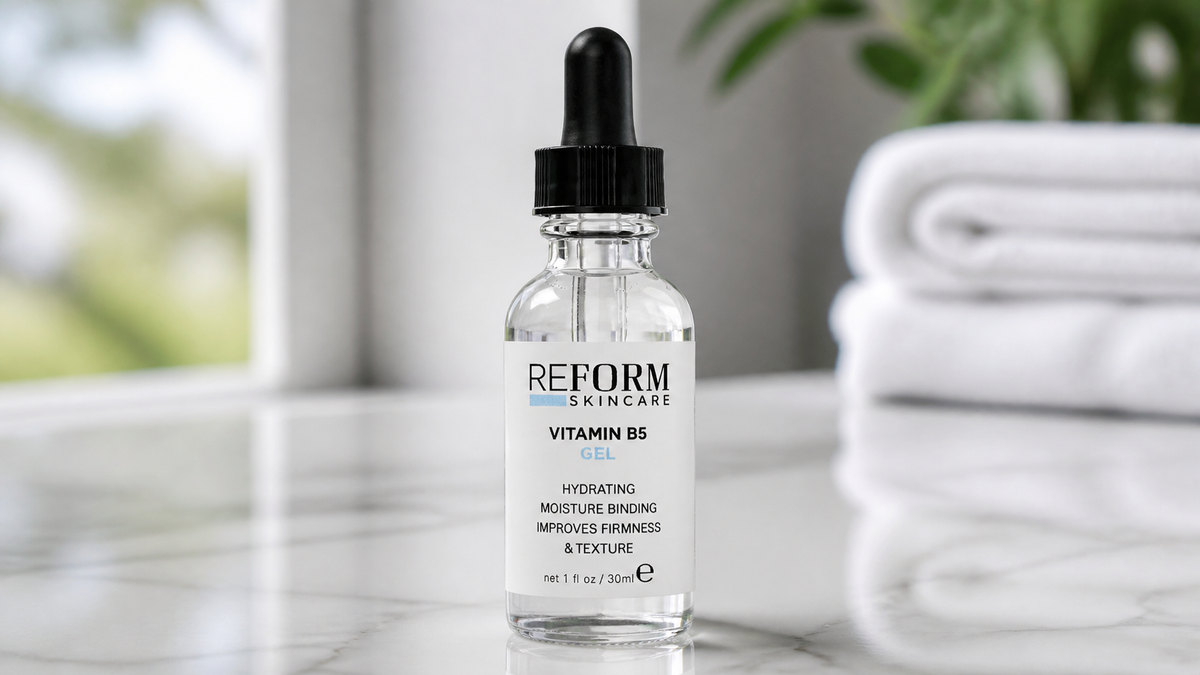
Among the doctor-formulated options, REFORM Skincare makes a Vitamin B5 Gel built precisely on this principle: a fast-absorbing gel that replenishes hydration and supports the skin's natural barrier, described as leaving skin calm and balanced with daily use.
If you want to see where it fits for your own skin, browse the full range at.
The bottom line
Deep hydration is a water problem with a barrier solution, and it needs both halves working in sequence. Vitamin B5 delivers the water-binding half with unusually good evidence behind it, and the gel format delivers it in a texture light enough for daily, twice-daily use across nearly every skin type. Add a moisturiser over the top, wear sunscreen in the morning, and the tight, flaky feeling that sends people hunting for new products tends to resolve itself.


Leave a comment
This site is protected by hCaptcha and the hCaptcha Privacy Policy and Terms of Service apply.